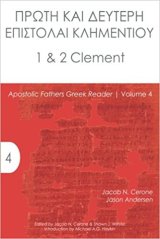
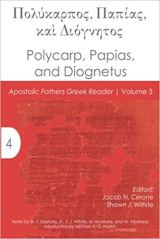
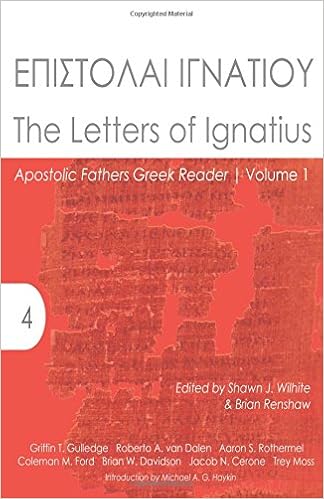
We Have a Winner

Thanks to Scott Hess for entering the contest and winning. Scott got 9/10 of the translations correct. Here are the original questions.

1) ζηθι מנ

2) βαβα βα βα βααα εγω ειμι αγαπησας αυτον

3) εστιν ΒΩ καιρος

4) φαγετε μαλλον ορνιν

5) εχετε αυτον ὁδον σου

6) ὁ δακτυλος ὁ επιλειχος ὁ καλος

7) ὑποοδον, φαγετε γλυκυς

8) συναγαγετε περι καλον λογον

9) ερχεσθε νειστεις, απερχεσθε μακαριος

Scott’s answers were:

1.
2. Baba ba ba baaa I’m loving it
3. It’s BO time
4. Eat more chicken
5. Have it your way
6. Finger licking good
7. Subway, eat fresh?
8. Gather around the good stuff?
9. Come hungry, leave happy

The only one he missed was number one…which is…”Live Mas.” Thanks to Mary Beth for suggesting I used Greek and Hebrew to represent the English and Spanish “Live Mas.”

Scott, I will get the book to you asap!

Posted in Greek, Greek Resources | Leave a comment

Greek Course: Official Announcement

As promised, here are the details about my forthcoming Greek Grammar I course. It will be offered at Cary Alliance Church (4108 Ten-Ten Road Apex, NC. 27539). The class will run once a week for an hour and a half. We will begin meeting Thursday, January 17th 2013 from 7:00-8:30PM. We look forward to seeing you there.

Also, for those who know Greek already, or know how to use a lexicon, don’t forget my contest to win Using New Testament Greek in Ministry ends Friday at 12:00AM. I’ve received one response with 9/10 correct. Can you do better?

Posted in Greek, Teaching | Leave a comment

Pottpourri

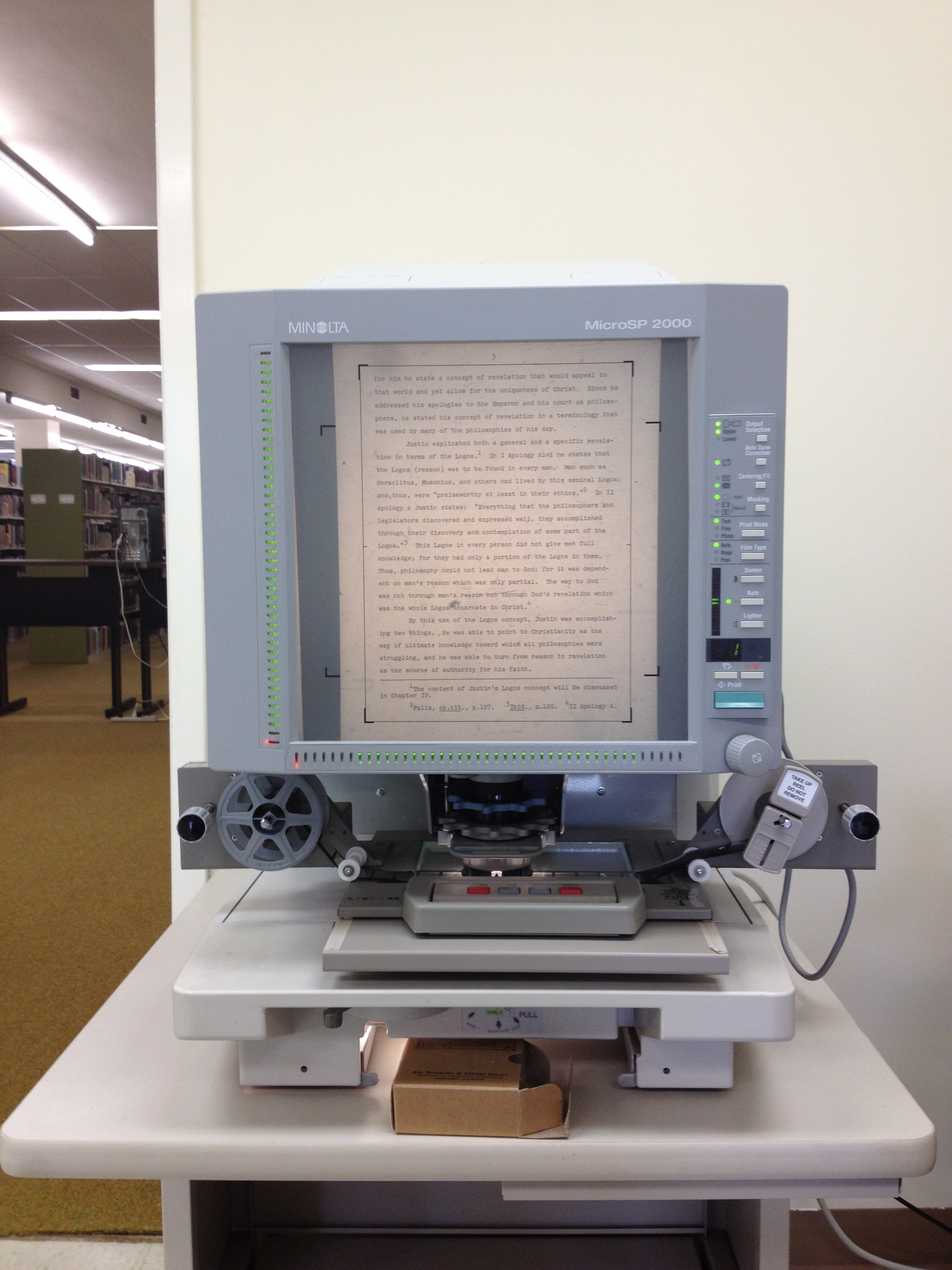
Today I went up to the library in order to read Willis Shotwell’s dissertation The Exegesis of Justin Martyr. I finished reading all 150 pages on microfiche. Take away? Justin was influenced by both Hellenism and Palestinian Judaism. This means that he employed both Hillel’s exegetical rules and the popular interpretive method of allegory. All these methods are to be understood as functioning in service of his Christo-centric understanding of Scripture.

I came home to find that Amazon had arrived. I hope everyone likes their Christmass presents this year. I know that my wife will love the Fire Pit I bought for the deck. This might be one of those gifts that we don’t ever get around to wrapping because we want to open it up and put it to use immediately. What could be better than brining a camp fire feel to your back yard?

Now I am sitting down to a NC State basketball game while I prepare for Hebrew class tomorrow. I need to make a vocabulary quiz, read ahead in our syntax book, and translate ahead in both Judges and Ruth.

What’s on tap for tomorrow. Well, I provided another pic for you. Here are 34 resources I need to make my way through. I have reviewed about 6 so far…only 28 to go. Even with all these sources, I don’t think I will be equipped to write this paper. Oh the woes of not knowing French and German. So many more relevant resources would be available!

Posted in Early Church Writings, Life | Tagged , , | Leave a comment

A New Milestone

Today marked a new milestone in my academic pursuits. To date I have avoided using the microfilm. But there comes a time in every budding scholars work that the relic of microfilm must be undertaken. First, I had to find where the machines were located, then I needed to find the book I needed, and then figure out how this thing works. Honestly, it’s pretty cool. Oh, and it is easier to make copies once the film is in place. I think I may be a bit more excited about this than I should be.

Now, back to reading an entire dissertation on the Exegesis of Justin Martyr.

Posted in Early Church Writings | Leave a comment

The Power of First Impressions

Last night I settled in for some reading. It was finally time to make some headway on my “Justin Martyr’s Exegesis of the Old Testament” paper. I was reading through the usual background sources when I came to Roger Olson’s The Story of Christian Theology. Reading a couple of paragraphs immediately brought back memories.

This book was required reading for my first class in Historical Theology. We were required to read this text alongside a number of primary sources as we worked our way from the 1st century until the 18th. I was surprised by how formative this work was in my conceptualization of Church Theology. I see historical theology through the lens of Olson. Categories I thought to be my own are Olson’s. First impressions are quite powerful.

This experience has forced me to be mindful of the books that I require for reading when teaching. Uncritically selecting a text book can permanently affect the way students conceive of a topic. I know that in the past I have always taught my Greek Grammar courses using Nathan Croy’s A Primer of Biblical Greek. It was the text from which I was taught. I knew the book backwards and forwards. If someone asked me what chapter the second aorist was in, I could answer “Lesson 14.” It had become altogether familiar. It was easier to teach.

Familiarity will no longer suffice. Care should be taken in the selection of introductory material. This is especially true when you only require one text book. I personally think that one text is never sufficient. Supplementary material should always be required in order to provide a balanced perspective. I realize this is a difficult task. We must introduce students to new disciplines without overly complicating matters. It is easy to get lost in the haze of scholarly discord. Nevertheless, we should strive all the more to better communicate to our students.

As a side note, the responsibility is not entirely on the back of the professor. Dr. Quiggle, my Historical Theology I professor, did everything he could to teach us how to read critically. He forced us to evaluate Olson against the primary sources. It is the responsibility of the student to read critically and to read widely.

Posted in Early Church Writings, Religion, Teaching | Tagged , , , | Leave a comment

A Labor of Love: Before and After

The day before Thanksgiving, my lovely bride said, “I want to make a pie.” I said, ” I LOVE BLUEBERRY PIE!” Mary Beth went to the store and bought everything needed. She didn’t take the easy route. She made her own pie filling with fresh blueberries.

I only later learned out that she doesn’t even like blueberry pie. She made it just for me. I felt horrible…until I ate the pie.

This is what the pie looked like before I got to it.

After

Now, before you are too judgmental of my gluttony, my family did eat half. What happened to the other half? Well, I couldn’t let me wife think her pie was bad now could I?


Posted in Life | Tagged , , | Leave a comment

Biblical Greek and the Local Church

Many of my friends have read this blog over the past week and have suffered through a number of posts on biblical Greek. I hope I haven’t scared you away from furthering your knowledge of biblical Greek or your desire to learn biblical Greek.

On that note, I thought it would be a good time to announce that I will be offering a biblical Greek class to all interested. The class will start sometime in January at Cary Alliance Church which is located in Apex, N.C. We will be using Dr. Black’s Grammar Learning to Read New Testament Greek. As always, the class will be offered free of charge. More information will be provided at a later time.

My goal is to bring you from not knowing the alphabet (with the exception of maybe α, ω, and π) to being able to read the New Testament. I will stick with you as long as you stick with me– just ask my Hebrew Students who are in the middle of translating Judges and Ruth.

Email me at jacobncerone@gmail.com if you are interested. Again, this is an open invitation. If you know of anyone in the area, spread the word. The more the merrier.

Posted in Greek Resources, NT Greek | Tagged , | Leave a comment

SBL Chicago in Hindsight: A Student’s Perspective

SBL Chicago was quite the experience. I was able to go back to the city where it all started.

In 2004 I set out from my parent’s home in North Carolina in order to attend Moody Bible Institute. At the time, I wanted to be a youth pastor. I had seen the impact my youth pastor had on me and wanted to impact others for Christ in the same way. As the years went by and my love of the study and need of answers increased, I discovered that there were myriad ways I could impact others for Christ. Eight years later I find that my desire to serve Christ in the ministry and in academia has not slackened. In light of that, I found myself in Chicago once again, this time attending the Society of Biblical Literature.

This year the conference was held in McCormick Place. I think that a more appropriate name for it would have been McCormick Palace. It felt like I walked well over a mile going from the West building to the East.

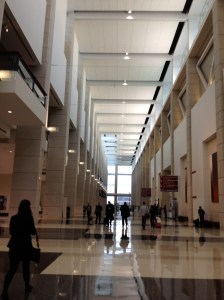
The center was equipped with a Starbucks, which had a perpetual wait of 30mins, multiple food courts (by my count there were at least three), and a massive exhibit hall filled with books. Here’s a picture of the exhibit hall from the outside.

All of this is to say, the whole event was intimidating. The list of presenters in the back of the SBL program was like a mini phonebook. Which presentations do I see? Who do I try to meet? How do I not get lost in a crowd?

The first thing you should know, though I only realized this to be the case after the conference was over and upon further reflection, is to narrow your interests. Sure, it would be nice to hear something on the Septuagint, a little something about Greek, a little something about the Fathers, etc. But don’t get too eclectic.

SBL is structured around study groups. For instance, there is the International Organization for Septuagint and Cognate Studies, SBL Biblical Greek Language and Linguistics Section, and SBL Book of the Twelve Prophets Section. Within each of these study groups, anywhere from 3-5 presentations are given. For most groups, one session takes place each day of the conference. My advice? If you are interested in the Septuagint, attend all of the sessions. Why? Why would I attend the session “Deuterocanonical Books and Beyond” if I have no interest in the papers presented in that section?

I’m glad you asked. All the heavy hitters, and the not so heavy hitters, who make the Septuagint their life’s work will be in attendance. After the third day of regularly attending meetings on the Septuagint, those individuals caught on that, I, like them, happen to be interested in the Septuagint. This is how I was introduced to Drs. Gentry, Meade, Gallaher Branch, Kreuzer, and others. Here’s how the conversation went, “Hey, I have seen you around and I don’t think we’ve met. I’m Robert Meade, what’s your name and where are you from?”

It takes only one person to speak with you and the rest will come in droves. This is because you are no longer a purveyor. You have become a participant in the conversation.

Second, show up early to each one of the sessions. You may think that lounging around in the common areas is the way to make new friends, but it is not. Everyone is on the move. If you show up early to sessions, pull up a seat, take out a book, and read until the next person walks in, that person will more than likely be one of the presenters. Even though they may have presented a thousand times, they are still nervous. They want to make sure everything is in order, the projector is still there, there is water on the table, etc.

After their paranoia wears off, guess who is patiently minding their own business but eagerly awaiting a conversation? You! And, to inappropriately appropriate the phraseology in Ruth, chance upon chance you are the only person available to the presenter for a conversation in order to ease his or her mind before the session begins.

Third, many of you might have heard that SBL is the conference all the “liberals” attend. ETS is where it’s at. There, we are capable of embracing scholarship and the academic world in a safe environment. True, you won’t see a study group for “Gender, Sexuality, and the Bible Group” or “Queer Studies” at ETS. What you will most likely find, though, is a cult of personality and “sugar-coated exegesis.” When at ETS two years ago, I walked away disappointed. It may have been due to my session selection, but I found most (not all) of the presentations to be stale and lacking. It is not as if the cult of personality is absent at SBL. “Tom Wright,”  “John Dominic Crossan,” and “Bart Ehrman” are still headliners. Yet, it was simply my impression that the overall attitude was to forego these sessions for the business at hand.

Fourth, this point dovetails with the former. When walking into the exhibit hall, I expected to see huge spreads from publishing houses like Zondervan, Baker Books, and IVP. Each of these publishers had extensive exhibits, but they were all relegated to the edges. The center isles had SBL, Brill, T&T Clark, Eerdmans, Westminster John Knox, and the various Bible Societies. While one could argue that this is to be expected due to SBL’s liberal leanings, one cannot argue the fact that SBL, Brill, T&T Clark, et. al. publish the works that have significantly impacted a field of study. These works are typically dissertations, which would otherwise be tucked away in a library never to be read again, but have merited such high regard as to receive publication.

[[Disclaimer: Do realize that I am in no way saying that IVP, Baker Books, and Zondervan are bad houses. I am not saying all that books published by them are of lesser quality. Most of my library is composed of excellent reference works and monographs by these publishers. I am also not saying that attending ETS is fruitless. I am merely speaking in generalizations from my personal impressions]]

Fifth, there is no better way to have a natural conversation with a presenter than to listen attentively and ask insightful questions afterwards. It might surprise you to know that a topic of interest to the person you want to meet happens to be the topic they just spent the last 6 months preparing and 30 minutes delivering. Don’t be bashful, ask away.

Sixth, I have always thought that making and passing out business cards as a student is pretty cheesy. I’m not convinced that isn’t true. Yet, there were a couple of times where an exchange of contact information was necessary and I had no graceful way to say, “Hey, my name is Jacob Cerone, my email address and phone number are…remember me.” I will have to think on this one.

Seventh. If you are still with me, this one might be the most important. Attending SBL is invigorating. New life will be injected into your studies. It is easy to become discouraged when the same conversation takes place at your institution, a conversation you have become weary of. It is easy to become arrogant and jaded when you know all the answers your professor wants. SBL helped put things in perspective.

Never before have I felt so small (yeah, those of you with a short joke cooking, laugh it up). Never before have a felt so insignificant. How will I ever reach these heights?

In the end, SBL Chicago was a lot like College Chicago. In both cases I left my little home in North Carolina only to find that there was a much bigger world out there, one that I can hide from or learn to engage. It is easy to go home in despair, to hide from it all. It is a much harder thing to rely on Christ in order to serve him with excellence in my endeavors.

On a lighter note, SBL Chicago and College Chicago were the same in a few other ways…

Lou Malnati’s Deep Dish Buttered Crust Sausage and Pepperoni Pizza

Hole in the wall Allende’s Skirt Steak Burrito with their in house hot sauce

Chicago food has and always will be some of the best!

Posted in Biblical Studies, Exegesis, LXX, NT Greek, SBL | 2 Comments

Deuterocanonical Books and Beyond

The third and final meeting of the International Organization fro Septuagint and Cognate Studies was held last Tuesday. The topic of study, as I am sure you have already deduced, was “Deuterocanonical Books and Beyond.”

Karen Jobes Presiding

Robert Hiebert giving his paper, Recensional Activity in Greek IV Maccabees

Robin Gallaher Branch  giving her paper, A Literary Analysis of Selected Secondary Characters in the Books of Judith

Peter Gentry giving his paper, Were the Aristarchian Signs in the Fifth Column of Origen’s Hexapla?

Siegfreid Kreuzer on Old Greek, kaige, and the trifaria varietas – a new perspective on Jerome’s statement.

Talk about a humbling session. The vast amount of knowledge required of Siegfried Kreuzer to discern the rescensional activity of scribes within the LXX and challenge the current consensus that there is a Lucianic rescension and then to relate Jerome’s statement about three forms of the Greek text in a plausible way is mind boggling. I’m still not sure if I understood it all, if any.

Peter Gentry did not cover the material promised. Instead, his presentation focused on the meaning of the antisigma as a notation for textual variants. He intentionally created a cliff hanger so that we would come to next year’s meeting of the IOSCS in Munich. A side note about Dr. Gentry. He has a very dry wit. At first glance you might think otherwise, but he will bust your sides without even cracking a smile.

Robin Gallaher Branch’s discussion on the significance of the secondary characters in Judith was fascinating. She delivered her paper with excitement and enthusiasm, a stark contrast to the dry witty presentation given by Peter Gentry. Dr. Branch’s analysis showed us that the secondary characters, round and flat, allows us to beter see and understand the heroism of Judith. I had the privilege of speaking with her after the session. A nicer person you will not find.

Posted in Biblical Studies, LXX, SBL | Tagged , , , , , , | Leave a comment

Mystery Exegesis and the Meaning of Prophetic Scripture in Justin

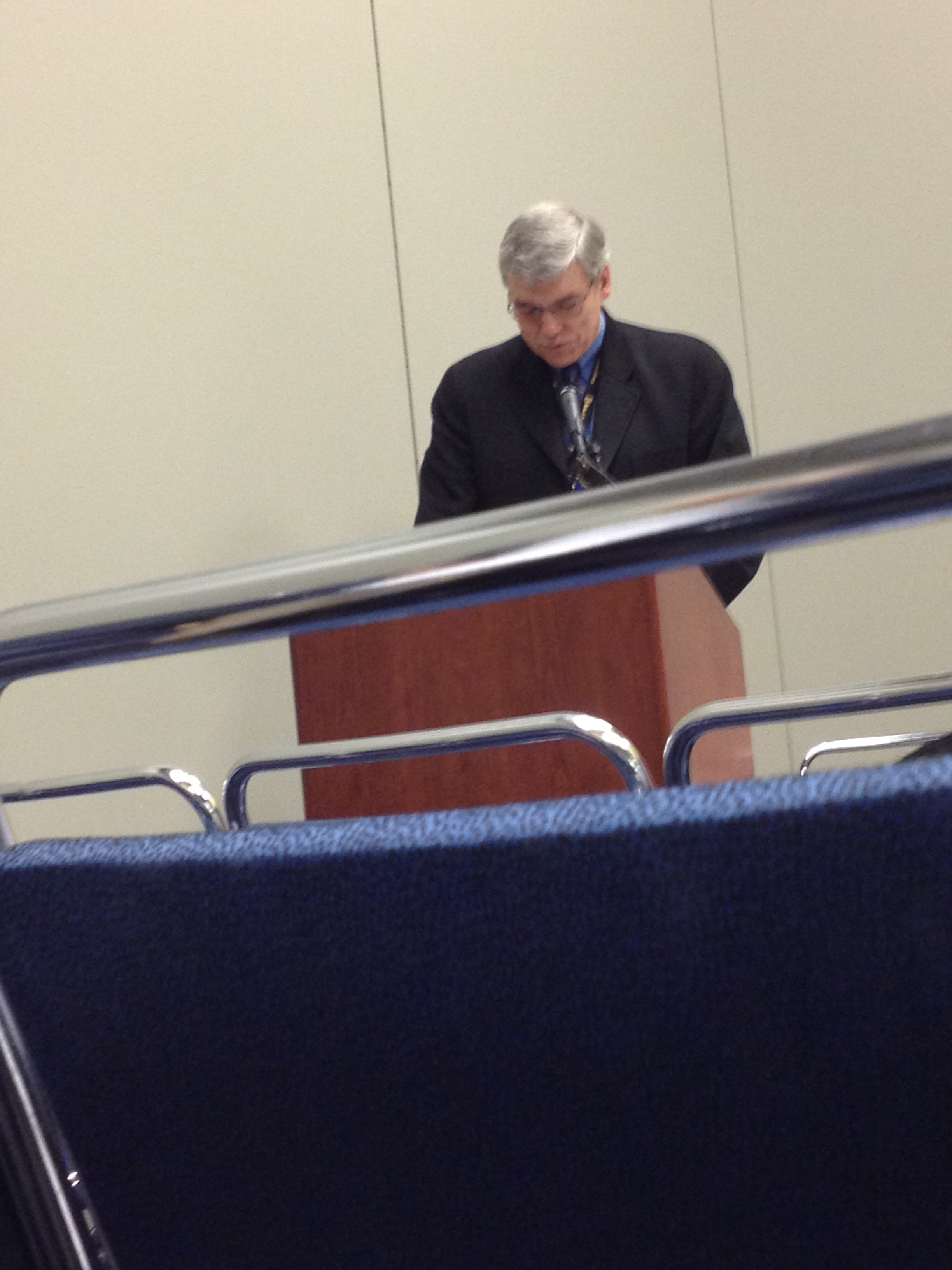
T.J. Lang, a doctoral candidate next door at Duke University, presented his findings on Justin Martyr’s exegetical foundations in his Dialogue with Trypho. Lang’s presentation was concise and insightful. The crux of the presentation was what distinguished a distinctly Christian reading from a traditional Jewish understanding of prophetic Scripture.

Lang began by highlighting Justin’s distinct usage of the Greek word μυστηριον “mystery.” The word appears 29 times throughout the Dialogue whereas τυπος “type” only occurs 11. The frequency with which μυστηριον is used over against that of τυπος dictates a closer investigation.

Lang ably demonstrates that, according to Justin, one is not capable of rightly understanding Old Testament prophetic scripture without having been shown these mysteries by the Holy Spirit. This formulation has ties back to the Pauline conception of the Church as a μυστηριον “mystery.” Though the μυστηριον was present, it was not understood until a later time. The best way I can explain this is through the cliche expression, “hidden in plain sight.”

For Justin, this “hidden in plain sight” concept applies to a correct reading of prophetic scripture. It is not until the Spirit enlightens the soul that the interpreter is capable of seeing the scriptures in a Christological fashion.

This mystery exegesis has further implications. The Old Testament believers would not have been able to put this all together. After all, it was hidden. It was a mystery. It is not until after the Christ event that these things have been made clear.

In no way does this compromise the Old Testament text. Justin is capable of establishing continuity between the Old Testament in the New Testament believes. The Jews, as represented by Trypho, were not capable of understanding because their minds have not been enlightened. This does not make it any less the case that Christ is the proper referent of prophetic scripture.

Much more can be said about this. As a matter of fact, I will be writing a paper on this same topic. I will probably tease out the implications μυστηριον has for Justin’s straightforward (literal?) and typological readings of Old Testament texts.

Posted in Early Church Writings, Exegesis | Tagged , , , | Leave a comment