“Reconstructing the OG of Joshua”

Now, which of you took a look at the title of this post and said, “that sounds like a revetting topic of study?”  Me neither.  The first half of the article was excruciatingly boring and difficult to follow.  Granted, this could have been due to the fact that all I had to eat this morning/afternoon was a bowl of soup, some mac and cheese, sour patch kids, and m&ms, oh yeah, I was also lying down.  After I woke up and the vestiges of sleep slowly faded into lucidity, I found the article quite fascinating.

Kristin de Troyer wastes no time in introducing her reader to the striking differences between the LXX and MT’s (Masoretic Text) version of Joshua 10:15, 23, and 43.  Although there are other differences between the two texts, the one of central concern for her purposes is the omission of verses 15 and 43 from the OG (Old Greek).  Within the MT these two verses report Joshua and Israel’s movements back to Gilgal after two major battles.

On the surface it would appear as if this makes the MT reading the more difficult of the two.  See, Joshua would have to travel out from Gilgal into battle, returned to Gilgal, then travelled out to Makeda in search of the five kings only to return back to Gilgal.  This is a lot of movement within a short period of time, whereas the Greek “omissions” would have allowed Joshua to travel from one location to the next.

de Troyer proposes two solutions to the problem of Joshua 10: 1) the translator acted with a free hand and eliminated perceived difficulties, 2) the Vorlage (the text behind the translation) did not have verses 15 and 43.  It is unlikely that the translator acted freely as he/she consistently translated Gilgal in all other instances.  It is more likely, according to de Troyer, that a different Hebrew text lay behind the OG.

But what about the fact that the OG reading seems to be the easier reading?  de Troyer finally shows her hand.  Upon further analysis the structure of the Hebrew text reveals that the presence of Gilgal in these two verses further supports the literary structure of the book as a whole.  In these two instances Gilgal serves as a marker for the conclusion of the first battle and the last battle in a series.

Pretty straightforward right?  Why I am so interested in the article?  It raises a question in my mind, unknown/intended by the article itself.  Which reading is to be preferred?  Wait.  Didn’t you say that the OG reading, the older reading, doesn’t support the presence of these two verses?  Well, yes.  There has been a great deal of attention garnered from those of the compositional approach to the Old Testament.  These additions to the MT seem to be the result of a redactor’s final touches on the text, which scholars such as Sailhamer, if I have understood him appropriately, would not necessarily discredit as the inspired work of the Spirit working through the redactor.  After all, we are taught to read the book of the Twelve prophets as if their canonical arrangement lends to some meaning, i.e. Jonah is to be interpreted in light of the threat of God’s forthcoming wrath to be executed against Israel if they do not repent (a theme throughout the Twelve).  The union of the Twelve through authorial intent (both human and divine) is oft accepted by the scholarly community.

So, in other words, did the Spirit inspire the redacted or non-redacted text?

Which text is to be preferred?

Posted in LXX | Tagged | Leave a comment

“The Hermeneutics of Translation in the Septuagint of Genesis”

Robert J. V. Hiebert, one of the translators of the book of Genesis in NETS, walks his reader through his translation decisions in Genesis 17.  As I have previously mentioned, the NETS adopts an “upstream” method of interpretation.  Hiebert concedes that the “LXX eventually came to be read and interpreted without reference to its Hebrew or Aramaic parent,” but it is the aim of the translation committee to focus on the initial phase of its reception.  A phase when the text would have been undoubtedly compared to the original Hebrew/Aramaic, either through memory or physical comparison.

Since Hiebert provides far too many examples for an efficient summary here, I will briefly mention the one element I found most helpful.  Hiebert cites BDB’s definition for ו in order to establish that it has a wide and free usage: or, then, but, notwithstanding, howbeit, so, thus, therefore, and that (just to name a few).

Despite the extreme flexibility and wide range of meaning the Hebrew ו possesses, the Greek translator opts to retain the Hebrew parataxis (the act of placing side-by-side/the linking of clauses with a simple coordinating conjunction) by consistently rendering it with καί “and,” “even,” “also.”  Such is the nature of a translation, while parataxis is persevered καί is forced to bear a load it was never meant to carry.

Posted in LXX | Tagged | Leave a comment

“Contemporary Translations of the Septuagint: Problems and Perspectives”

Wolfgang Kraus has provided his reader with a brief guide through the available translations of the Septuagint.  He focuses on their guiding methodologies which lead to certain strengths and weakness.

At the outset we encounter the tension between a translation as dependent upon its parent text and the translator’s intentional or unintentional changes to the text as well as the life breathed into the text by those who utilize it.

Kraus, based on the work of Marguerite Harl, identifies two polar extremes when identifying translational approaches to the LXX: upstream and downstream.

The upstream perspective is interested in 1) the translator and how he understood the text before him, 2) reconstruction of the translation technique utilized by the translator, 3) the text-critical use of the Septuagint.

In stark contrast to this approach is the downstream perspective.  The translator’s concern lay primarily in the text’s reception.  The Septuagint, according to this view, is independent and autonomous and should be treated thus when translated into a new language.

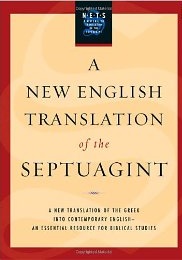
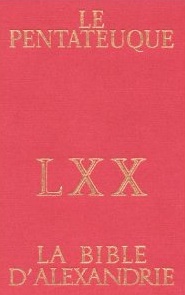
This information is important when he addresses two main translations on the market: New English Translation of the Septuagint and La Bible d’Alexandrie.

= Upstream/an Interlinear/text is tied to Hebrew parent text.

= Downstream/Concern for how Jewish and Christian Communities came to understand the Greek OT.

Having classified these translations according to opposite ends the “translation perspective” continuum, Kraus, a chief contributor of the Septuaginta-deutsche project, is able to steer a mediating course.  Kraus argues that neither a reader-response nor an inter-linear (my terms) approach to the Septuagint is sufficiently capable of reconciling the extant data (i.e. the document’s textual-linguistic makeup).

There is no doubt the text shares uncanny similarities with an interlinear, almost to the point of unintelligible isomorphism (equal/same form).  But the textual makeup of the Septuagint also includes four elements that suggest more than an interlinear approach is in play: 1) intentional plot changes, 2) intended enculturation to the milieu or the social environment of the target language (avoiding anthropomorphisms, harmonization of texts), 3) intended shift in theological conceptions (the book of Esther’s conception of God), and 4) intended modifications concerning theological topics (Israel and the Nations, Temple).  All four of these elements suggest that the translator’s theology and social setting are factors in the resultant translation.

The author concludes by reassuring us that a committee is working on the translation of the Septuagint in German with an accompanying volume full of annotated explanations for their choices in translation.

Posted in LXX | Tagged | 1 Comment

An Inquiry

I was recently asked the question, “Who is your target audience?” Considering the widely divergent nature of my posts (daily events, flash cards, LXX), that is a fair question. It might be better to answer that by providing my purpose for this blog.

I have three purposes in writing on this blog:

  1. An act of discipline: writing on a daily basis will teach me to write with a great economy of words and will help me improve my style. It will also force me to evaluate the way I spend my time. If I haven’t written a post for the day, it most likely means that I didn’t have anything worthy of mention and by extension I have wasted a day.
  2. I intend that those interested be able to peer into my head on any given day. So in a sense, this is a public journal.
  3. Finally, I intend to provide brief summaries of the research/reading I do throughout the week. I realize that this might become overbearing for the causal reader. I am including them as much for me as it is for the chance reader that is interested in my current reading. Writing these summaries will serve the purposes of a robust annotated bibliography for further research and formal writing.

ἐνθύμησις means “the content of thinking, a thought, or opinion.” So sure, in a way I would relate the overall product of the blog with Penses. I am not presumptuous in thinking that it will share any similarity to Pascal’s work with the exception one possible exception: what will make it on the blog will simply be the byproduct of my thoughts for the day. My hope is that you might discover you share some of my interests and that it will benefit you in some way.

Posted in Uncategorized | Leave a comment

“Translation as Scripture”

Yesterday, if you will recall, we spoke about articulation and re-articulation as it relates to the Septuagint. Articulation was the result of the translator’s work, i.e. the Septuagint. Re-articulation is how that translation came to be interpreted by the communities that utilized that translation.

Benjamin G. Wright III provides us with an explanation for how and why interpretation of the Septuagint that can be characterized as re-articulation became acceptable practice in some Jewish communities and the early Christian Church.

Do you remember the story of the 70 (or 72) from your high school bible class/bible college/or seminary? 70 (or 72) scribes, commissioned by King Ptolemy, were contracted to provide a translation of the Jewish Torah/Pentateuch. These scribes, depending on which version of the story you were told, worked together for 72 days and produced a translation which all 72 learned and upright men were agreed (as if this claim isn’t miraculous enough [72 scholars/scribes in complete agreement about anything] some versions of the story claim that the seventy-two separated into solitary cells. In solitude each scribe inspired by the Spirit inscribed the same translation). This story is based on the Letter of Aristeas and has experienced “some” embellishment throughout the centuries.

Wright argues that the Letter of Aristeas was developed as a piece of propaganda in support of the Septuagint. According to Wright, the Septuagint was originally intended as an introduction to the Hebrew text. After several decades the text developed in popularity and independency not previously experienced. No longer was it viewed as a dependent text, subservient to the Hebrew original. It had ultimately gained independence and authority. This newfound independence would not hold up to scrutiny if it was unable to substantiate its history. Thus, the Letter of Aristeas appeared as an attempt to place the Greek text on par with the Hebrew.

If the Greek text, according to Aristeas, was in complete agreement with its corresponding Hebrew text, then it shared the same divine inspiration and authority. Thus, there remained no need to check the Hebrew text. The work of interpretation could be done without reference to the original Hebrew. After all, the Greek says the same thing.

Posted in LXX | Tagged | Leave a comment

Miscellaneous

  1. I began reading A.W. Tozer’s The Pursuit of God for a second time today. I read it many years ago but am now revisiting it as a part of my ordination requirements within the C&MA. While I do not believe the book accurately reflects the cultural milieu in which we find ourselves today, its resounding call for orthopraxis is a timeless message. As Christians we are not simply called to subscribe to the party line or a list of right doctrines, though this indeed is of great importance. We are to ardently seek after God. As Christians, we must taste and see that God is good.
  2. I meet with my ordination coach today at 11:30. Let’s hope all goes well.
  3. I finally finished one complete cycle through Metzger’s entire vocabulary list. 87% correct. That’s 881/1066. Only 185 words left to learn. Time to buckle down.
  4. I’m slowly making my way through the vocabulary in Matthew. This project may take a while. Understatement much? I think so.
Posted in Uncategorized | Leave a comment

Warning Two: “Exegesis in the Septuagint: Possibilities and Limits (The Psalter as a Case in Point)

So far it appears as if the articles in Septuagint Research are all composed as warnings for those conducting research within the Septuagint. As it might happen, I am a novice and I hope to do research in the Septuagint…soooo, yeah, warnings are good.

Working from the axiom that all translation is interpretation, Albert Pietersma examines the matter of what constitutes significant interpretation. Pietersma writes, “That the very act of translating is interpretation is an oft stated truth and, it seems to me, not subject to controversy. What may possibly be open to some dispute is my contention that not all such interpretation can be called exegesis. Consequently, the real question to be asked is not whether interpretation takes place in the transfer from the source language to the target language, but what level of interpretation takes place, and whether it is meaningful to dub any given level of interpretation ‘exegesis’” (34-35).

Pietersma establishes three criteria for interpretation to qualify as exegesis: 1) deliberate-ness, 2) methodical-ness, and 3) target oriented-ness. This threefold criteria is intended to elucidate whether the translator was acting as a medium (a minimalistic view of interpretation via translation) or an author (a maximalist view).

This should come as no surprise to the reader. Nevertheless Pietersma’s warning is substantiated by the tendency of Septuagint scholars to make much of a translator’s lexical selection on the basis of re-articulation (that is that interpretation of the Greek text by later interpreters, e.g. Asterius the Sophist and Didymus the Blind). Pietersma concludes by warning his reader to not confuse articulation (the translator’s work) with re-articulation (the interpretation of the translator’s work within dogmatically distinctive communities).

I will leave you with a few of Pietersma’s words:

“If its textual-linguistic make-up argues for a translation characterized more by formal correspondence than by dynamic equivalency, one’s approach to hermeneutics in the Septuagint should accord with that. As I see it, that means at a minimum that exegesis need to be demonstrated, not presupposed. From that perspective I would suggest that one work from the least intelligible phenomena to the more intelligible; that one proceed from the word level to high levels of constituent structure; that one pay more attention to deviations from the translator’s Hebrew-Greek defaults than to the defaults and standard equations or, to put it differently, that greater weight be given to what is unpredictable than to what is predictable; that mere representation of the source text does not constitute exegesis of the source” (45).

Posted in LXX | Tagged | Leave a comment

“In a Mirror Dimly”

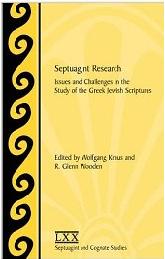
I finished the first article in the book  Septuagint Research: Issues and Challenges in the Study of the Greek Jewish Scriptures. In his article “In a Mirror, Dimly—Reading the Septuagint as a Document of Its Times,” Cameron Boyd-Taylor sounds a warning for scholars and prospective students of the Septuagint. Boyd-Taylor makes the reader aware of the fact that the LXX is not a homogenous document. The documents we currently associate with the title, “Septuagint” have been the result of numerous translators, at various points in time and in the context of countless communities.

The layers of complexity associated with the Septuagint must make the student/scholar cautious when seeking to identify “…evidence for some specific intellectual or religious development, which can then be pinned down historically. Such use of the Septuagint is frequently made by students of Christian origins, who wish to trace an intellectual trajectory from some social formation in Hellenistic Judaism through to the world underlying the New Testament” (15-16). Boyd-Taylor uses the work of Jonathan Z. Smith on the Greek version of Ps 15:9 as example.

Herein ἐπ’ ἐλπίδι “in hope” translates לבטח “to trust/to be secure/secure.” Combined with the LXX’s rendering of שחת “the Pit” as διαφθοράν “corruption,” Smith concludes that this translation is a product of a Proto-Pharisaic scholar. That is to say, the Greek rendering of this Psalm results in a resurrection theology.

Psalm 16:9-10

Therefore my heart was glad, and my tongue rejoiced;

Moreover my flesh will tent in hope

For you will not abandon my soul to Hades,

or let your devout one see corruption.

This conclusion is founded upon a number of assumptions that must not be allowed to go unchecked:

1) that “in hope” has obtained a degree of terminus technicus, i.e. eschatological hope.

2) that “corruption” is not within the semantic range of “the Pit” (Boyd-Taylor shows otherwise)

3) the translators intention is, in essence, to provide an interlinear for his readers

4) and that the appropriate Sitz im Leben “life-setting/context” can be accurately discerned.

I thought these criticisms would have led Boyd-Taylor to “Finish Him” in his conclusion. Instead, he concedes the fact that ἐλιπίδι is “far afield” semantically and something can indeed be said for its presence. He left me even more baffled with his final words, “We have to proceed carefully, since, on the one hand, there were undoubtedly more sectarian formations in Second Temple Judaism than are attested in our sources, and on the other, it is difficult to identify issues on which such parties as we know of can be securely contrasted. Having said this, it is worth considering that there may well be specific halakic matters on which we might yet be able to identify Proto-Pharisaic tendencies within the Septuagintal corpus, but that is a subject for another day” (31).

It is intimidating to enter a field where the conclusions are so tentative. And yet, it is a reminder to the Textual Critic, no matter his material, that internal evidence can often be used to make a case for both sides of the argument.

Posted in LXX | Tagged | Leave a comment

Work for the day.

For all interested, spell check does not exist. Well…it does…just not for Koine Greek. The result? I spent the first 3-4 hours of my day individually checking each flash card for Metzger’s list. To what end? I believe I have eliminated most of the major errors…no cards left out and no longer are definitions incorrectly paired with Greek words. I ask you, the user, to make me away of any other misspellings or misplaced diacritical marks.

Despite this major overhaul, I have started my development of the uses from 1-9 in the New Testament. I have decided to separate all proper nouns into its own list (thanks to Nathaniel Cooley for advice on this matter). How far have I progressed? Ha! I have gotten through Matthew chapters 1-10.

On that note, I am thinking that I will save each book as a separate unit as I compile the complete list. This way the student who is studying a specific book in the NT will not get bogged down with all the vocabulary. Instead, he/she is able to learn the 1-9 vocabulary for that specific book. If Metzger is learned (as it should be after the fourth semester) [hey…don't judge me for the fact that I am still working through the list myself.  Yes…I know I have taken at least 8 semesters of Greek, I said don't judge] then this should make work through any particular book manageable.

Posted in Uncategorized | Leave a comment

My Flash Cards

As I promised last night, I have completed the flash card lists for the following:

  1. Dr. David Black’s Grammar
  2. Metzger’s list from 10-500+ uses in the NT,
  3. and a frequency list of 100-8000+ uses within the LXX.

As you can see, Jazz got a little impatient with me taking so long and demanded that I find some way to accommodate her.  Here she is hanging out with me while I work.

You can find the cards here http://quizlet.com/user/jacobncerone/. Remember, if you have an ipod touch or ipad, you can download the application flashcardlet from the app store, free of charge. Trust me, after the amount of money I have spent of useless flashcard apps, this is a steal of a deal.

Forthcoming:

  1. A frequency list from 1-10 uses in the NT,
  2. Hebrew frequency list based on Mitchell.
Posted in Greek Resources | Tagged | Leave a comment