Review of Paul and Mark

coverMy review of Paul and Mark: Two Authors at the Beginning of Christianity for The Religious Studies Review went live this month. If you have a subscription to the journal, you can find it here.

Otherwise, you’re welcome to peruse the copy I’ve uploaded to academia here.

Posted in Uncategorized | Leave a comment

T&T Clark Companion to the Septuagint

55836Logos now has T&T Clark’s Companion to the Septuagint up on Pre-pub for only $26.99 (it retails at over $170). I’d advise you to pick this up quick.

I’ve been looking forward to getting this for a while and I’m glade it’s finally affordable. I love Dines’ work on the Twelve and am excited about exploring the other essays.

[[Edit: If you’re wondering why I’m excited about this volume, here are a few brief reasons.

The Companion functions as an excellent introduction to each of the books of the Old Greek of the Old Testament, including a discussion on text-transmission, textual witnesses, translation technique, unique theological views as evidenced in the translation, and the literary characteristics of the translation. If you have already read Jobes and Silva and want to dig into a specific book of the LXX, this is the place to start. It will also give you a substantial up-to-date bibliography of resources that discuss that book of the OG OT.]]

Posted in Uncategorized | Leave a comment

NT Use of the OT: Upcoming Feature for Logos Now

I’m really excited about the next release of Logos Now, scheduled to drop December 14th. It’s the New Testament Use of the Old Testament interactive. Have you ever wanted to find what book contains the most references to the Old Testament? Or how about how many times a particular Old Testament book is referenced? This interactive lets you explore these references and even compare them to the New Testament to see whether the New Testament author relied on the Hebrew text or the Septuagint text.

Check out a video I created demonstrating exactly how this feature works.

I’ve been excited about the release of this feature and am excited about using it in my own study, especially for books like Matthew and Hebrews.

Posted in Uncategorized | Leave a comment

Children and Ecclesiastes

There is no better tutor for the book of Ecclesiastes than a two year old asking you to play blocks:


Posted in Uncategorized | Leave a comment

Reading for Fun: Richard Hooker-A companion to His Life and Work

As many of you know, I recently attended the ETS and SBL conferences in Atlanta last month. This is always a great time to catch up with old friends, meet new ones, and be surrounded by individuals consumed by the study of topics within your own field and those in tangential fields.
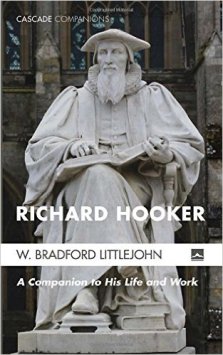
516X7hI2+tL._SX311_BO1,204,203,200_During ETS, I got to meet Brad Littlejohn through an old college friend, Mike Lynch. Brad has recently published Richard Hooker: A Companion to His Life and Work through Wipf and Stock. Despite the fact that I’m not familiar with Hooker’s work or Anglicanism and the fact that I’m in many ways a Puritan at heart, he graciously gave me a copy of the volume.

I’m glad he did. As it turns out, the book was written for me—or, at least, those like me. In the preface, Littlejohn writes,

First, I hope to introduce Hooker to audiences that have barely heard of him, if at all. It is a sad fact that a great many educated, intelligent, theologically-interested readers, especially in North America, fall into this category.

Elsewhere in the preface he writes,

Most of what has been written and read about Hooker, it seems, has remained confined to the Anglican Communion, which claims him for its own, and not unreasonably so. But it is unfortunate that so many Protestants in other traditions should have so thoroughly conceded him to the Anglicans as not to even bother reading him. Few theologians, I wager, have so much to teach American evangelicals.

Now, this would be the place in the post where I go and review the book, telling you about everything that it contains and then give you a few places where I think he could have done a better job. But, this blog already does that—and quite well I might add. (And, for the record, I agree with that reviewer’s comment: “This companion to Hooker’s life and work by Brad Littlejohn is fascinating, learned, straightforward, well-written, engaging, and balanced . . . . I really enjoyed it, and the point of this review is that you or someone you love should enjoy it as well. I understand Christmas is coming up.”)

Instead, I want to briefly comment on how nice it was to finally sit down and read something for pleasure that’s completely unrelated to my current field of study. Sure, I read books on text-linguistics (or discourse analysis if you prefer), Greek, the Septuagint, and 1 Clement, and they are all for pleasure. But being able to return to a former love, theology, and take a load off while comfortably making my way through a well-written book that is not full of pretension, but instead gently introduces the reader—as a companion volume should—to the life and thought of another was simply and truly enjoyable.

And I even learned a bit along the way. Like, for instance, that non-Puritan theologians of the time had something valuable to say. (Yes, that was said with the greatest irony possible, especially considering the life and work of Hooker.) In seriousness, one of the best things to glean from the volume is the relevance of Hooker’s theological method for theologians today—mainly, his emphasis on the necessity of discriminating between essential and non-essential issues as it pertains to faith, practice, and, more generally, law.

On that note, I’ll leave you—as I said at the outset, this would be a brief reflection—with Littlejohn’s concluding thought:

If the contemporary church can learn anything from the wisdom of Richard Hooker, then, I hope that it can learn this extraordinary balance of exclusion and inclusion, of dogmatism and relativism, of history and change, of authority and freedom, of certainty and doubt that gives the Laws of Ecclesiastical Polity “such seeds of eternity . . . that shall last till the last fire consume all learning.”


Posted in Uncategorized | 4 Comments

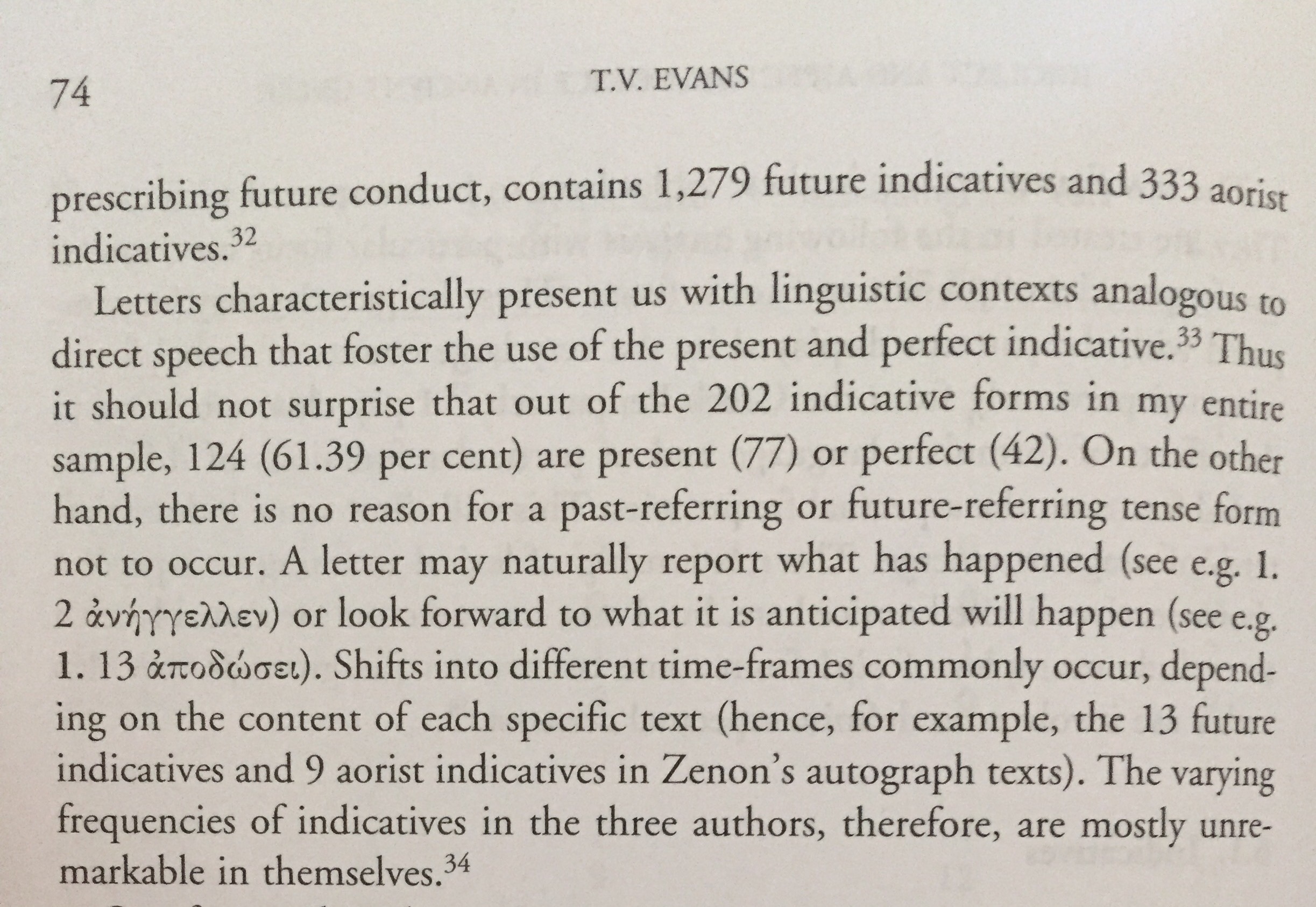
Evans: Idiolect and Aspectual Choice in Ancient Greek

Here’s a gem from the newest addition to my library, Biblical Greek in Context.

 Grammaticalization of tense within the indicative mood of Koine Greek, you don’t say?

Posted in Uncategorized | 2 Comments

Biblical Greek in Context

Well, ETS/IBR/AAR/SBL came and went. I did my very best to show restraint when walking through the book exhibits. I think I did a pretty good job for the most part—took home 13 books and only had to buy two of them.

But, Peeters publishing house finally won out in the end. I couldn’t pass up this new volume in the Biblical Tools and Studies series.

12308714_802466275629_359666352402940125_n.jpg

Even so, I’m surprised I didn’t buy every volume they had in the series. But, as many of you know, Peeters—though not as bad as Brill—does not sell cheap books. Conference price for this gem was $50. Like I said, though, I couldn’t pass it up. Which brings me to a very important lesson I’ve learned about myself:

3049308

Posted in Uncategorized | 3 Comments

Review of Youngblood’s “Jonah: God’s Scandalous Mercy”

Screen Shot 2015-08-11 at 8.30.35 AMNew Orleans Baptist Theological Seminary has released their newest edition of The Journal of Baptist Theology and Ministry. It includes my review of Kevin Youngblood’s excellent commentary on the book of Jonah. If you’re interested, you can find it here.

Posted in Uncategorized | 1 Comment

N.T. Wright on the Pericope of the Adulteress

I decided to peruse several commentaries I have on the book of John to see what they have said about the pericope of the adulteress. Do they say it’s original or not, and what are the reasons offered for their decisions?

What I found, as you might have already guessed, is that virtually every single one of them claim that the pericope was a later addition to the Gospel and provide two reasons for this conclusion: 1) it is not included in many of the earliest extant manuscripts of the Gospel, appearing first in the Greek-Latin diglot of the fifth century Codex Bezae and 2) it disrupts the Tabernacles discourse which would be remedied with no lose to the narrative/discourse if omitted.

But, and here’s where one might find himself or herself frustrated to no end, none of these commentaries provide any sustained reason for why or how it interrupts the discourse, only that it does.

I found it interesting, however, that N. T. Wright provides arguments in favor of its omission due to its interruption of the Tabernacles discourse as well as arguments in favor of its inclusion due to the fact that, if omitted, the discourse suffers when interpreters look for a reason for the character change Jesus undergoes later in chapter eight. He writes:

There is a puzzle about this story. It doesn’t really seem to fit here. Chapters 7 and 8—omitting this passage—seem to flow on reasonably well. And, tellingly, the earliest copies of John’s gospel do in fact run straight on from 7:52 to 8:12, missing this story out altogether. At the same time, some manuscripts put it in, but in a different place. Some have it as an extra story after the end of the gospel. Some even place it in Luke’s gospel (and it has to be said that the way the story is told is, if anything, more like Luke than like John). That’s why some translations of the Bible put the story in brackets, or add it to the end as an ‘appendix’.

At the same time, there is something to be said for reading it here, where a lot of manuscripts do have it. John 7 has Jesus teaching in the Temple during the festival of Tabernacles, and the crowds and authorities getting increasingly interested in asking who he is and what he’s about. John 8 has an altogether darker tone, with Jesus accusing the Judaeans of wilfully misunderstanding him, failing to grasp what he’s saying, and wanting to kill him, because they are following the dictates of ‘their father, the devil’. Chapter 8 contains some of the harshest things Jesus is ever recorded as saying. What has happened?

It is as though Jesus has come face to face with the real problem at the heart of the Judaean attitude—to him, to God, to themselves, to their national vocation. We won’t understand the chapter if we think of the Judaeans as simply interested bystanders trying to make sense of a curious teacher newly arrived in town. If we read it like that, Jesus appears irrationally angry and dismissive, and indeed that’s what they seem to have thought too (see verses 48 and 52). John, writing the chapter, is well aware of the impression Jesus was making.

The chapter fits, in other words, with a change of mood brought on by something which has caught Jesus’ attention, and has made him realize just how steeped in their own patterns of thinking his Judaean contemporaries had become—and how devastatingly unlike God’s patterns of thinking they were. So, whether or not the story of the woman and her accusers originally belonged here, it certainly helps us to understand the chapter which it now introduces. The chapter as it now stands begins with people wanting to stone a woman to death; it ends with them wanting to stone Jesus. Perhaps that, too, is trying to tell us something.*

Whatever one concludes about the originality of the pericope of the adulteress to John’s Gospel, it does not suffice to say that omitting the story remedies all problems within the discourse of the Gospel. We should investigate what ties, themes, and elements are developed and strengthened by its inclusion, what elements become more difficult to explain upon its removal, and what elements are easier to explain and make more sense when excluded.

Just because everyone else says it’s so don’t mean you proved it!

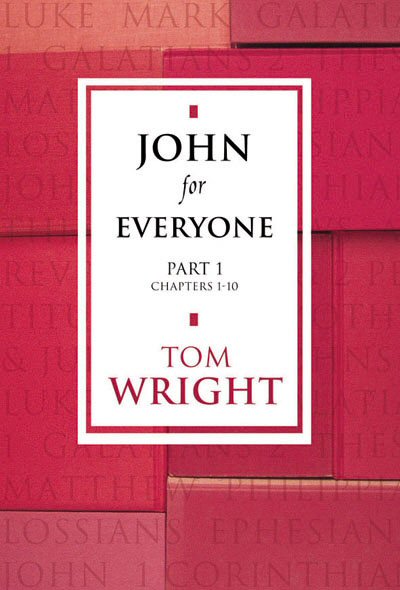
Tom Wright, John for Everyone, Part 1: Chapters 1-10, (London: Society for Promoting Christian Knowledge, 2004), 11–112.

Posted in Uncategorized | 2 Comments

Book Announcement

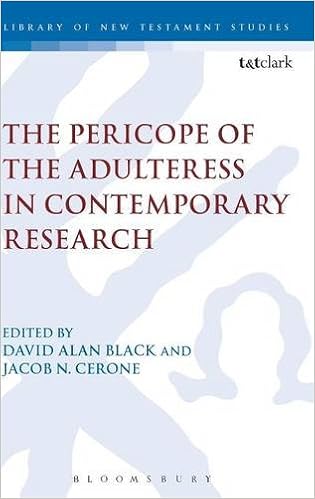
pericopeadulteraeLast April, Southeastern Baptist Theological Seminary hosted a conference on the  Pericope Adulterae. Conference participants discussed whether or not the passage of the woman caught in adultery was original to John’s Gospel or if it was a later interpolation.

I’m pleased to announce that the essays from the conference will be published by Bloomsbury’s Library of New Testament Studies!

The book will be titled The Pericope of the Adulteress in Modern Research and will be co-edited by David Alan Black and Jacob N. Cerone (!). The contents of the volume with their tentative titles are below:

Foreword:  Gail O’Day

Preface: David Alan Black

Introduction: Jacob N. Cerone

Chapter 1: John David Punch – “The Piously Offensive Pericope Adulterae

Chapter 2: Jennifer Knust – ” ‘Taking Away From’: Patristic Evidence and the Omission of the Pericope Adulterae from John’s Gospel”

Chapter 3: Tommy Wasserman – “The Strange Case of the Missing Adulteress”

Chapter 4:  Chris Keith – “The Pericope Adulterae: A Theory of Attentive Insertion”

Chapter 5: Maurice Robinson – “The Pericope Adulterae: A Johannine Tapestry with Double Interlock”

Chapter 6: Larry Hurtado – “The Pericope Adulterae: Where from Here?

Make sure to keep an eye out for its release. I’ll be sure to keep you updated as it gets closer to publication.

Posted in Uncategorized | 1 Comment