Recitation of Philippians 1:1-18

I just finished memorizing the next section. Here’s the video of my memory work in Philippians to date.

[Note: There are two mistakes in the video (I thought I was going to have it perfect this time . . . oh well): προφειας should have been προφάσει and τούτο should be τούτῳ. Both mistakes occur in verse 18.]

Posted in Greek, Greek Resources, NT Codices | Tagged , , , , | Leave a comment

Luke 6:40, Likeness Education, and Thomas Hudgins

photoThis afternoon I had the distinct privilege of sitting in on Dr. Thomas Hudgins‘ presentation to an EdD cohort at Southeastern. Thomas talked about his dissertation, Luke 6:40 and the Theme of Likeness Education in the New Testament. Thomas argued that likeness education cannot be understood purely in terms of content transfer. That is say, Christian education does not take place simply when information is disseminated. God calls each of us to make apprentices (disciples). What does it look like to make an apprentice? Paul’s description of his relationship with Timothy gives us an idea: “You, however, have followed my teaching, my conduct, my aim in life, my faith, my patience, my love, my steadfastness, my persecutions and sufferings . . .” (2 Tim 3:10-11; ESV). Thomas argued that likeness education includes imitation of one’s teacher in these areas:

  • teaching
  • conduct
  • purpose in life
  • faith(fulness)
  • patience
  • love
  • persecutions and sufferings

These various facets of likeness education are brought to bear on how we are to understand education throughout Luke, Acts, and the broader New Testament concept of the master-apprentice/teacher-student relationship.

It was clear in the presentation that Thomas has imitated his mentor, and is living a life that is worthy of imitation. Thank you, Thomas, for you excellent reminder that our goal in education is to become more like Christ.

By the way, Thomas’ dissertation has recently been published by Wipf and Stock. Having read it and learned much from it, I readily recommend you pick up a copy. It will serve as a gentle but necessary rebuke that all scholars, seminarians, and Christians need to hear: Behold Christ, and become like him.

Posted in Greek, Greek Resources, New Testament Studies | Tagged , , , , | 2 Comments

Cicero via Wheelock

This coming semester I will be working through Wheelock’s Latin once again. It is the required textbook for my Theological Latin course at SEBTS. Hopefully the vocabulary and paradigms will stick a bit better this time around. One thing Wheelock does well is incorporating a bit of humor within the lesson/exercises. Here is an except I found amusing:

“Exercitus noster est magnus,” Persicus inquit, “et propter numerum sagittarum nostrarum caelum non videbitis!” Tum Lacedaemonius respondet: “In umbra, igitur, pugnabimus!”

“Our army is great,” says the Persian, “and on account of the number of our arrows, you will not be able to see the sky!” Then a Spartan replies, “Therefore, we will fight in the shade!”

Cicero Tusc 1.42.101 via Wheelock p. 45

Posted in Latin | Tagged , , | Leave a comment

Translation Tuesday: Chrysostom Week 3

Remember, although I attempted to provide a footnote for all words used 20x or less in the New Testament with a gloss, I may have missed some. Also, you may not know all words used more than 20x in the New Testament. Don’t let that stop you from participating. Just visit Perseus’ word study tool here, copy and paste the word you don’t know, and get morphological information and definitions for that word.

Vocabulary

Week 3: Homily 1, Section 3b

Περιθώμεθα[1] τοῦτον τὸν κόσμον· μανιάκην[2] ἐργασώμεθα τῇ ψυχῇ χρυσοῦν, τὴν ἐλεημοσύνην[3] λέγω, ἕως ἄν ἐνθάδε[4] ὦμεν. Ἐὰν γὰρ παρέλθῃ ἡ ἡλικία[5] αὕτη, οὐκέτι αὐτῇ χρησόμεθα.[6] Πῶς; Οὐκ εἰσὶν ἐκεῖ πένητες, οὐκ ἔστιν ἐκεῖ χρήματα,[7] οὐκ ἔστιν ἐκεῖ πτωχεία·[8] ἕως ἐσμὲν παῖδες, μὴ ἀποστερήσωμεν[9] ἑαυτοὺς τοῦ κόσμου τούτου. Καθάπερ γὰρ ἐπὶ τῶν παίδων, ἐὰν ἄνδρες γένωνται, περιαιρεῖται[10] ταῦτα, καὶ ἐφ᾽ ἕτερον ἄγονται κόσμον· οὕτω καὶ ἐφ᾽ ἡμῶν· οὐκέτι ἡ διὰ χρημάτων ἐλεημοσύνη ἐκεῖ ἔσται, ἀλλ᾽ ἑτέρα τις πολὺ μείζων. Ὥστε ταύτης ἑαυτοὺς μὴ ἀποστερήσωμεν, ποιήσωμεν καλὴν φαίνεσθαι τὴν ψυχήν. Μέγα ἐλεημοσύνη καλὸν καὶ τίμιον.[11] δῶρόν ἐστι μέγα, μᾶλλον δὲ μέγα ἀγαθότης·[12] ἐὰν μάθωμεν χρημάτων καταφρονεῖν,[13] καὶ ἕτερα μαθησόμεθα. Ὄρα γὰρ ἐντεῦθεν[14] πόσα τίκτεται[15] ἀγαθά· ὁ διδοὺς ἐλεημοσύνην, ὡς χρὴ διδόναι, μανθάνει τῶν χρημάτων καταφρονεῖν· ὁ μαθὼν χρημάτων καταφρονεῖν, τὴν ῥίζαν[16] ἐξέκοψε[17] τῶν κακῶν. Ὥστε οὐκ εὖ ποιεῖ μᾶλλον, ἢ εὖ πάσχει, οὐ τῷ ὀφειλὴν[18] καὶ ἀμοιβὴν[19] κεῖσθαι μόνον τῇ ἐλεημοσύνῃ, ἀλλὰ καὶ τῷ τὴν ψυχὴν φιλόσοφον[20] γίνεσθαι, καὶ ὑψηλὴν[21] καὶ πλουσίαν. ὁ διδοὺς ἐλεημοσύνην παιδεύεται[22] μὴ θαυμάχειν χρήματα, μηδὲ χρυσόν· τοῦτο δὲ παιδευθεὶς τὴν διάνοιαν,[23] ἀρχὴν ἔλαβε μεγίστην ἀνιέναι[24] πρὸς τὸν οὐρανὸν, καὶ μάχης[25] καὶ ἔριδος[26] καὶ φθόνου[27] καὶ ἀθυμίας[28] μυρίας ἐξέκοψε προφάσεις.[29] Ἵστε γὰρ, ἵστε καὶ ὑμεῖς, ὅτι πάντα τὰ κακὰ διὰ τὰ χρήματα, καὶ μυρίοι πόλεμοι[30] διὰ τὰ χρήματα. Ὁ δὲ τούτων μαθῶν καταφρονεῖν, ἐν γαλήνῃ[31] κατέστησεν ἑαυτὸν, οὐκέτι ζημίαν[32] δέδοικε.[33] Τοῦτο γὰρ ἐπαίδευσεν αὐτὸν, οὐκέτι ζημίαν δέδοικε. Τοῦτο γὰρ ἐπαίδευσεν αὐτὸν ἡ ἐλεημοσύνη· οὐκέτι ἐπιθυμεῖ[34] τῶν τοῦ πλησίον·[35] πῶς γὰρ, ὁ τὰ αὐτοῦ ἀποκτώμενος,[36] καὶ διδούς; οὐκέτι βασκαίνει[37] τῷ πλουτοῦντι· πῶς γὰρ, ὁ βουλόμενος γενέσθαι πένης;[38] διακαθαίρει[39] αὐτοῦ τὸ ὄμμα[40] τῆς ψυχῆς. Καὶ ταῦτα μὲν ἐνταῦθα·[41] τὰ δὲ ἐκεῖ οὐδὲ ἔστιν εἰπεῖν, ὅσων ἐπιτεύξεται[42] ἀγαθῶν. Οὐ μενεῖ ἔξω μετὰ τῶν μωρῶν[43] παρθένων,[44] ἀλλὰ μετὰ τῶν φρονίμων[45] εἰσελεύσεται, μετὰ τοῦ νυμφίου,[46] τὰς λαμπάδας[47] ἔχων λαμπράς·[48] καὶ τῶν ἐν παρθενίᾳ ταλαιπωρηθεισῶν,[49] ὁ μηδὲ γευσάμενος[50] τῶν πόνων[51] ἐκείνων, ἀπὸ ταύτης ἔσται βελτίων.[52] Τοσαύτη ἡ τῆς ἐλεημοσύνης ἰσχύς·[53] μετὰ πολλῆς εἰσάγει[54] τῆς παρρησίας τοὺς αὐτῆς τροφίμους. Γνωρίμη[55] γάρ ἐστι τοῖς ἐν τῷ οὐρανῷ πυλωροῖς,[56] τοῖς τὰς θύρας κατέχουσι[57] τοῦ νυμφῶνος· οὐ μόνον δὲ γνωρίμη, ἀλλὰ καὶ αἰδέσιμος·[58] καὶ οὓς ἄν ἐπιγνῷ τετιμηκότας αὐτὴν, μετὰ πολλῆς εἰσάξει τῆς παρρησίας. καὶ οὐδεὶς ἀντερεῖ,[59] ἀλλὰ πάντες ὑποχωροῦσιν.[60] Εἰ γὰρ τὸν θεὸν εἰς τὴν γῆν κατήγαγε[61] καὶ ἔπεισεν ἄνθρωπον γενέσθαι, πολλῷ μᾶλλον ἄνθρωπον εἰς τὸν οὐρανὸν ἀναγαγεῖν δυνήσεται. Μεγάλη γὰρ αὐτῆς ἡ ἰσχύς. Εἰ οὖν ἀπὸ ἐλέου; καὶ φιλανθρωπίας ὁ θεὸς ἄνθρωπος ἐγένετο, καὶ ἔπεισεν αὐτὸν δοῦλον γενέσθαι, πολλῷ μᾶλλον τού; δούελους εἰς τὴν οἰκίαν εἰσάξει τὴν αὐτοῦ. Ταύτην ἀγαπήσωμεν, ταῦτην στέρξωμεν,[62] μὴ μίαν ἡμέραν μηδὲ δευτέραν, ἀλλὰ διὰ παντὸς τοῦ χρόνου, ἵνα ἡμᾶς ἐπιγηῷ· ἂν αὐτὴ ἡμᾶς ἐπιγνῷ, καὶ ὁ Κύριος ἐπιγνώσεται· ἂν αὐτὴ ἀγνοήσῃ, καὶ ὁ Κύριος ἀγνοήσει, καὶ ἐρεῖ· Οὐκ οἶδα ὑμᾶς. Ἀλλὰ μὴ γένοιτο ταύτης ἀκοῦσαι ἡμᾶς τῆς φωνῆς, ἀλλὰ τῆς μακαρίας ἐκείνης· Δεῦτε, οἱ εὐλογημένοι τοῦ Πατρός μου, κληρονομήσατε τὴν ἡτοιμασμένην ὑμῖν βασιλείαν ἀπὸ καταβολῆς[63] κόσμου· ἧς γένοιτο πάντας ἡμᾶς ἐπιτυχεῖν, χάριτι καὶ φιλανθρωπίᾳ, ἐν Χριστῷ Ἰησοῦ τῷ Κυρίῳ ἡμῶν, μεθ᾽ οὗ τῷ Πατρὶ, καὶ τὰ ἐξῆς.


[1] Περιθώμεθα from περιτίθημι “to put on” [Used 8x in NT; 52x in LXX]

[2] μανιάκην from μανιάκης “necklace” [Used 0x in NT; 4x in LXX]

[3] ἐλεημοσύνην from ἐλεημοσύνη “alms, charity” [Used 13 times in NT; 56x in LXX]

[4] ἐνθάδε from ἐνθάδε “here, to this place” [Used 8x in NT; 1x in LXX]

[5] ἡλικία from ἡλικία “time of life, life span, height” [Used 8x in NT; 22x in LXX]

[6] χρησόμεθα from χράομαι “to use; warn, declare” [Used 0x in NT; 11x in LXX]

[7] χρήματα from χρῆμα “possesions, wealth” [Used 6x in NT; 41x in LXX]

[8] πτωχεία from πτωχεία “poverty” [Used 3x in NT; 19x in LXX]

[9] ἀποστερήσωμεν from ἀποστερέω “to defraud” [Used 6x in NT; 8x in LXX]

[10] περιαιρεῖται from περιαιρέω “to take away; abandon” [Used 5x in NT; 6x in LXX]

[11] τίμιον from τίμιος “precious, rare, honorable” [Used 13x in NT; 40x in LXX]

[12] ἀγαθότης from ἀγαθότης “goodness” [Used 0x in NT; 0x in LXX]

[13] καταφρονεῖν from καταφρονέω “to presume, despise” [Used 9x in NT; 22x in LXX]

[14] ἐντεῦθεν from ἐντεῦθεν “from here, on this side” [Used 10x in NT; 28x in LXX]

[15] τίκτεται from τίκτω “to bear children” [Used 18x in NT; 236x in LXX]

[16] ῥίζαν from ῥίζα “root, origin” [Used 17 in NT; 56x in LXX]

[17] ἐξέκοψε from ἐκκόπω “to cut off, down, destroy” [Used 10x in NT; 48x in LXX]

[18] ὀφειλὴν from ὀφειλή “debt, duty” [Used 3x in NT; 0x in LXX]

[19] ἀμοιβὴν from ἀμοιβή “exchange, alternation, repayment” [Used 1x in NT; 0x in LXX]

[20] φιλόσοφον from φιλόσοφος “philosopher” [Used 1x in NT; 4x in LXX]

[21] ὑψηλὴν from ὑψηλός “high, proud” [Used 11x in NT; 214x in LXX]

[22] παιδεύεται from παιδεύω “to instruct, disciple” [Used 13x in NT; 88x in LXX]

[23] διάνοιαν from διάνοια “mind, thought, intention” [Used 12x in NT; 69x in LXX]

[24] ἀνιέναι from ἀνίημι “to send back, throw up, lift up, forgive, relax [Used 4x in NT; 43x in LXX]

[25] μάχης from μάχη “battle, quarrel, strife [Used 4x in NT; 32x in LXX]

[26] ἔριδος from ἔρις “quarrel, strife” [Used 9x in NT; 3x in LXX]

[27] φθόνου from φθόνος “envy” [Used 9x in NT; 4x in LXX]

[28] ἀθυμίας from ἀθυμία “faintheartedness” [Used 0x in NT; 2x in LXX]

[29] προφάσεις from πρόφασις “false motive, pretext, excuse” [Used 6x in NT; 3x in LXX]

[30] πόλεμοι from πόλεμος “war” [Used 18x in NT, 380x in LXX]

[31] γαλήνῃ from γαλήνη “calmness” [Used 3x in NT; 1x in LXX]

[32] ζημίαν from ζημία “loss, penalty” [Used 4x in NT; 5x in LXX]

[33] δέδοικε from δείδω “to fear” [Used 0x in NT; 8x in LXX]

[34] ἐπιθυμεῖ from ἐπιθυμέω “to lust, desire” [Used 16x in NT; 55x in LXX]

[35] πλησίον from πλησίον “neighbor” [Used 17x in NT; 214x in LXX]

[36] ἀποκτώμενος from ἀποκτάομαι “to lose possession of, alienate” [Used 0x in NT; 0x in LXX]

[37] βασκαίνει from βασκαίνω “to bewitch, begrudge, deceive” [Used 1x in NT; 4x in LXX]

[38] πένης from πένης “day-laborer, poor person” [Used 1x in NT; 78x in LXX]

[39] διακαθαίρει from διακαθαίρω “to clean out” [Used 1x in NT; 0x in LXX]

[40] ὄμμα from ὄμμα “eye” [Used 2x in NT; 10x in LXX]

[41] ἐνταῦθα from ἐνταῦθα “here, hither, at the very time, then” [Used 0x in NT; 32x in LXX]

[42] ἐπιτεύξεται from ἐπιτυγχάνω “to obtain, attain, be successful” [Used 5x in NT; 2x in LXX]

[43] μωρῶν from μωρός “foolish” [Used 12x in NT; 7x in LXX]

[44] παρθένων from παρθένος “virgin” [Used 12x in NT; 64x in LXX]

[45] φρονίμων from φρόνιμος “wise” [Used 14x in NT; 40x in LXX]

[46] νυμφίου from νυμφών “wedding hall, bridal chamber” [Used 3x in NT;  2x in LXX]

[47] λαμπάς from λαμπάς “lamp” [Used 9x in NT; 16x in LXX]

[48] λαμπράς from λαμπρός “bright, illustrious” [Used 2x in NT; 6x in LXX]

[49] ταλαιπωρηθεισῶν from ταλαιπωρέω “to be sorrowful, suffer distress” [Used 1x in NT; 17x in LXX]

[50] γευσάμενος from γεύομαι “to taste, experience” [Used 15x in NT; 0x in LXX]

[51] πόνων from πόνος “labor, toil, pain” [Used 4x in NT; 93x in LXX]

[52] Comparative from ἀγαθός

[53] ἰσχύς from ἰσχύς “strength, might” [Used 10x in NT; 326x in LXX]

[54] εἰσάγει from εἰσάγω “to bring in” [Used 11x in NT; 153x in LXX]

[55] Γνωρίμη from γνώριμος “well-known, acquaintance” [Used 0x in NT; 7x in LXX]

[56] πυλωροῖς from πυλωρός “gate-keeper, door-keeper, janitor” [Used 0x in NT; 30x in LXX]

[57] κατέχουσι from κατέχω “to hold, withhold” [Used 17x in NT; 47x in LXX]

[58] αἰδέσιμος from αἰδέσιμος “exciting shame, venerable” [Used 0x in NT; 0x in LXX]

[59] ἀντερεῖ from ἀντέρω “to speak against, gainsay” [Used 0x in NT; 0x in LXX]

[60] ὑποχωροῦσιν from ὑποχωρέω “to go back, retire, withdraw” [Used 2x in NT; 1x in LXX]

[61] κατήγαγε from κατάγω “to bring down, lead down” [Used 9x in NT; 68x in LXX]

[62] στέρξωμεν from στέγω “to cherish, love” [Used 0x in NT; 1x in LXX]

[63] καταβολῆς from καταβολή “foundation, building, structure” [Used 11x in NT; 1x in LXX]

Posted in Early Church Writings, Greek, Greek Resources, Translation Tuesdays | Tagged , , , | Leave a comment

The Joy, Frustration, and Fear of Having a Child

This evening I experienced a mixture of three emotions: joy, frustration, and fear. I’m quite certain my experience is not unique. For many of you, this might bring back memories.

Elijah soaks up everything I do. He watches me intently. He mimics my movements. He is more concerned about what is in my hands than he is with the toys in his own. So when he starts reaching for my diglot of Thomas Aquinas’ Summa Theologica, more than a little part of my soul is warmed.

IMG_1029

And yet, this creates a bit of a frustration. If Elijah wants what daddy has, then it makes it very difficult for me to get anything done throughout the day. Case in point:

IMG_1031

Elijah’s need to have electronics in his hands does not stop there. He gets very excited whenever he is allowed to play with my phone.

IMG_4340

Which brings us to the fear aspect of having a child. If he is already picking up on my likes, dislikes, and habits this early, he is going to share the same strengths and weaknesses I have. No, this isn’t any new revelation to me, or to you for that matter. It is, though, powerful to see yourself mimicked, both the good and the bad, in your child. For those that have walked this road ahead of me, I’m sure you are thinking, welcome to my life. Well, it also is my life now . . . and I might want to think a little about putting away the phone and the computer every now and then.

[Note: If Elijah could speak, he would cry out “I’ve been set up. That evil man put those things in front of me so he could take these pictures.” Of course, he would be right, but that in no way exonerates him from past behavior ;)]

Posted in Life | Leave a comment

Reading the Sealed Book

I’m currently reading J. Ross Wagner’s book Reading the Sealed Book: Old Greek Isaiah and the Problem of Septuagint Hermeneutics. This is an enjoyable read that should be on the radar of anyone studying the Septuagint. I am currently reading Wagner’s detailed account of his methodological approach, which relies heavily on Cameron Boyd-Taylor’s adaptation of Descriptive Translation Studies in his “interlinear approach.” I’m looking forward to seeing how Wagner applies this methodology and the interpretive upshot it provides for Isaiah. Hopefully it will aid me, to some degree, in my approach to the Septuagint version of Jonah.

Posted in Greek, Greek Resources, LXX | 3 Comments

Nahum, Jonah, and Exodus

Connections between Nahum and Jonah are unavoidable. The first question the reader of Jonah asks is, “Why is God concerned with Nineveh? What have they done to merit his wrath?” Nahum provides an explanation the author of Jonah chose to leave out:

Woe to the bloody city, all full of lies and plunder– no end to the prey! The crack of the whip, and rumble of the wheel, galloping horse and bounding chariot! Horsemen charging, flashing sword and glittering spear, hosts of slain, heaps of corpses, dead bodies without end– they stumble over the bodies! And all for the countless whorings of the prostitute, graceful and of deadly charms, who betrays nations with her whorings, and peoples with her charms (Nahum 3:1-4; ESV)

Nahum’s depiction of Nineveh’s sin fills out the two words used in Jonah to describe her sin: Nineveh is evil (1:2) and violent (3:8).

A more subtle connection that readers make between the two books is their use of Exodus 34:6-7. In this passage, God reveals himself as merciful, compassionate, loving, willing to forgive, but will also punish the guilty.

I have been aware of this connection for some time now. Yet, my good friend Nathaniel Cooley pointed out the unique way each author makes use of this creedal text. It wasn’t until I started preparing for my Sunday School class on Nahum, however, that I understood what he was getting at.

Jonah’s quotation of Exodus stops in a peculiar place. He only mentions the compassionate part of God’s statement: “I knew that you are a gracious God and merciful, slow to anger and abounding in steadfast love.” Why stop here? God goes on to say that he will not overlook the sins of the guilty. He will punish sinners according to their deeds. If Jonah was going to complain, wouldn’t it have been more logical to say, “Why spare Nineveh? What about your covenant? Are you blind to their sin?” The fact that he does not reveals that he knows his God better than we might give him credit for. Then again, his orthodoxy is never in question.

Nahum, like Jonah, is tasked with proclaiming an oracle against Nineveh. He too makes use of Exodus 34:6-7. Yet, he seems unaware of the first part of God’s statement. He writes, “The Lord is slow to anger and great in power, and the Lord will by no means clear the guilty” (Nahum 1:3).

So you can see the relationship between these texts, below is a citation of Exodus 34:6-7. Red signifies the part of the quotation that appears only in Nahum. Blue signifies the part of the quotation that only appears in Jonah. Bold signifies that it occurs in both authors’ citations.

6 The LORD passed before him and proclaimed, “The LORD, the LORD, a God merciful and gracious, slow to anger, and abounding in steadfast love and faithfulness,  7 keeping steadfast love for thousands, forgiving iniquity and transgression and sin, but who will by no means clear the guilty, visiting the iniquity of the fathers on the children and the children’s children, to the third and the fourth generation.

Jonah emphasizes the grace of God and his love even for Nineveh. Nahum brings the justice of God to the fore. Nineveh must pay for her sins.

Both texts make use of the phrase “slow to anger” in a unique way. For Jonah, this fact provides a justification for Nineveh’s reprieve. Nahum uses the phrase to highlight the fact that Nineveh has sinned long enough. God has suffered long. He has grown impatient, and his wrath burns. He will not “clear the guilty.” Nineveh will be destroyed.

What does this mean for our interpretation of Jonah and Nahum? Are they to be interpreted as separate entities? Are they to be interpreted together? Is Jonah primarily about grace and Nahum primarily about judgment? Are these quotations additions by a later editor? I don’t have answers to these questions yet, but it does make me wonder if I need to expand my focus to an inter-textual reading of Jonah.

On a more pastoral level, however, it is clear that both Jonah and Nahum teach us about different facets of God’s character. He is gracious; he will not clear the guilty. This doesn’t make him capricious or contradictory. To make a jump into the New Testament, Jesus provides clemency to all who are found in him. God’s wrath has been poured out onto him. Believers experience the free gift of his grace. Those who spurn this free gift will themselves experience God’s wrath poured out upon them. Their iniquities will not be cleansed.

Posted in Hebrew, Jonah, Old Testament Studies | Tagged , , , , , , , , | 10 Comments

Why I Have a Love/Hate Relationship with the Book of Jonah

Those of you that read this blog on a regular basis know that I post a lot about the book of Jonah. I thought it might be helpful if I explain why. First, my Master of Theology thesis topic is on the book of Jonah. As such, there are very few days that go by that I’m not reading a commentary, scholarly article, or translating texts (MT, LXX, Targum, Medieval commentaries, etc) of/on the book of Jonah. The second reason forms the content of this post.

At the center of the book of Jonah lies a dual theme: judgment and grace. The book opens with God’s declaration of coming judgment against Nineveh. Jonah’s flight provokes God to send a storm wherein Jonah is threatened with God’s judgment. God delivers the sailors from the storm after they throw Jonah overboard. Jonah’s residence in a great fish, “דג גדול,” is open to debate. Was it an act of mercy or an act of judgement? After Jonah pronounces that the city of Nineveh will be overturned, the people repent and God relents from his intent to destroy the city. As Jonah sits in the open heat, he experiences deliverance in the form of shade and judgement in the destruction of that shade.

How, then, are we to understand Jonah? Is he an object of wrath or an object of mercy? Does he ultimately repent, or does he serve as a perpetual example of hypocrisy?

Some days I wake up and think I finally have an answer. The author depicts Jonah in stark ironic contrast to the pagan sailors and the pagan Ninevites. Jonah, a prophet of the one true God, who knows good orthodox theology (1:9; 4:2), refuses to repent. While it is true that he does what God commands in chapter three, chapter four reveals that his qualms with the original mission God called him to has not changed. He was upset the Ninevites would be spared in chapter one, so he fled. Now that they have repented and God’s wrath has been sated, he is mad that the Ninevites repentance and God’s forgiveness is actualized. Jonah remains unchanged. How can a prophet be mad that men, women, and children are spared from physical and spiritual death? He is a villain.

Other days I wake up and am reminded of the fact that God could have used another prophet. He could have let Jonah drown in the sea and picked a new messenger. Instead, he extends grace to his reluctant prophet. Even after the mission is accomplished, he lovingly and compassionately comes alongside his prophet. He tends to his needs as an act of grace. Then he allows Jonah to experience a certain amount of discomfort in order instruct the prophet in his ways. The abrupt ending allows us to contemplate the continuing mercies God will show to his prophet. Will Jonah finally see the mercies of his covenant Lord and repent?

In Exodus 34:6-7, a passage used by the author of Jonah (4:2), we see God claiming both grace and wrath as essential to his character:

The LORD passed before him and proclaimed, ‘The LORD, the LORD, a God merciful and gracious, slow to anger, and abounding in steadfast love and faithfulness, keeping steadfast love for thousands, forgiving iniquity and transgression and sin, but who will by no means clear the guilty, visiting the iniquity of the fathers on the children and the children’s children, to the third and fourth generation.”

The story of Jonah is an exposition of this text in narrative form. We cannot get away from either God’s wrath or his mercy. The two cannot be separated. When I emphasize the fact that Jonah is ironically portrayed, made to play the fool, and is a hypocrite, it causes me to sit in judgment and forget the grace God has extended him. When I extend grace to Jonah despite all these things, I minimize and come close to forgetting the fact that he does not repent. There is no surety that he has a right relationship with his God.

These struggles await the reader, await me, on the other side of chapter 4. Chapter 5 is the story of Jacob Cerone. It is your story. How will we respond to God’s relentless and gracious pursuit? Will we concede to him in word? Will we concede to him in deed? Or will we concede in word and deed as we bend our desires to his by the work of his Spirit?


Posted in Hebrew, Jonah, Old Testament Studies | Tagged , , , | 4 Comments

Starting Anew

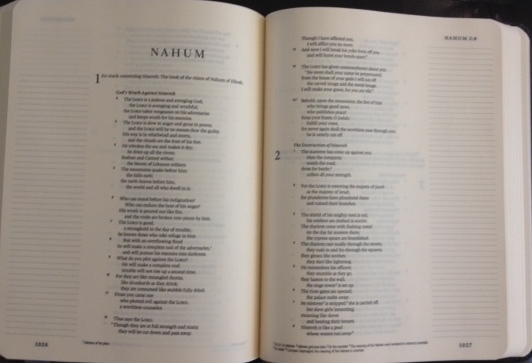
It’s time. It’s time for a new Bible. I’ve had my ESV since 2004. I bought it when I was a Freshman at Moody Bible Institute. It has been a constant companion since. Over the years, the daily wear and tear has taken its toll:

photo 4

photo 3

The only reason it lasted this long is because I use my Greek and Hebrew Bibles more frequently. There are times, though, when I teach through large passages of scripture, only have a week to prepare, and it is impractical to translate the whole passage. Instead, I will read through the text several times and make notes throughout:

photo 5This allows me to note connections, note the divisions, and note the pertinent elements. Then I teach from these notes. The great thing about this is the fact that when I return to the text a year later, I am able to see my notes at a glance. Sadly, I will be starting over anew:

photo 1

photo 2I know, I know. There are programs. As a matter of fact, I have Accordance. It is on my computer and my ipad. It is great for taking notes. I won’t ever lose them. Call me antiquated, but there is something lost in digital notes. You have to know where they are. You have to call them up. Writing notes on the page, underlining specific passages, drawing lines, making connections, and being able to see it all at a glance cannot be duplicated.

Now I have a Bible that will better accommodate the space needed to take effective notes. Though, let’s be honest, there is never enough space. Now, before I sign off, let me be clear about something. This isn’t a plug for the ESV journaling Bible. This isn’t an endorsement. Christians have far too many Bibles and don’t read them enough. Buying a new one isn’t going to make you read it anymore than you already do now. Simply put, mine was falling apart and it was time for a replacement.


Posted in Biblical Studies, Life, Teaching | 3 Comments

Jerome’s Justification of Jonah’s Flight

I am currently reading Barbara Green’s work Jonah’s Journeys in Liturgical Press’s Interfaces series. Green’s work centers around asking and providing some answers for three avenues of studies in Jonah: behind the text (historical considerations), within the text (the literary facets of the text), and in front of the text (an exploration of how readers have interpreted Jonah throughout history). Currently, I am reading about Jerome’s reception of the book. Green notes that Jerome is a generous reader. He attributes gracious motives to all the characters within the book.

According to Jerome, Jonah harbors no ill will towards the the Gentiles, Nineveh. He does not hate them. Instead, Jonah has the foresight to know that God’s redemption of the Gentiles entails the rejection of the Hebrews. This reality drives him to sacrifice himself for the salvation of his people. If this reminds you of something Paul says in Romans, you are right. Hear Jerome’s comments:

Seeing the ‘fullness’ of the gentiles; (Rom. 11:25) enter by stealth, and that fulfilled which is said in Deuteronomy: ‘they have provoked me with these which are not gods, and I will provoke them with a nation which is not, I will rouse them to wrath with a foolish nation’ (Deut. 32:21; Rom. 10:19), he despairs of the salvation of Israel and is agitated with great pain which bursts forth in his voice. And he reveals the reasons for his gloom an says, so to speak: ‘I alone have been chosen out of such a number of prophets to announce disaster to my own people through the salvation of others.’ He is not saddened therefore, as some think, because the multitude of the gentiles is saved, but because Israel is perishing.

Because of this also our Lord wept over Jerusalem (Lk. 19:41) and refused to ‘take the children’s bread and give it to the dogs’ (Mt. 15:26; cf. Mk. 7:27). The apostles also preached first to Israel (Acts 13:46), and Paul wished to be ‘anathema for his brothers, who are Israelites, whose are the adoption, and the glory, and the covenant, and the promises, and the Law, from whom are the fathers, from whom is Christ according to the flesh’. (Rom. 9:3-5) However, the ‘sufferer’ as Jonah is translated is well afflicted with suffering, and his soul is sad even unto death (Mt. 26:38; Mk. 14:34), for he endured many things–as much as was in him–so that the population of the Jews might not perish. The name of sufferer is also very fitting to the history, showing the prophet beset with difficulties and weighed down with the wretchedness of his journey and the shipwreck (p. 57-58).

-translated by Timothy Michael Hegedus in

Jerome’s commentary on Jonah: Translation with introduction and critical notes

What I find most interesting about Jerome’s comments is the parallel he draws with Paul. Paul is, for Christians, an admirable example. Like Paul, Christians are to be broken by unbelief. The spiritual death of family members,  friends,  neighbors, and our world should make us cry out like Paul, take my life for theirs. I would gladly sacrifice my life if it means the salvation of others. Paul recognizes, however, that this is foolhardy. It cannot be done. The only sacrifice that brings life is Christ’s, and he grants it freely to all. What is key for Paul, and for us, is brokenness for the lost.

Jerome’s connection between Paul and Jonah is a bit disconcerting. Even if we grant Jerome the premise that Jonah acts graciously, he knows God’s sovereign plan to save the Gentiles. Nevertheless, he seeks to thwart him. Jerome’s interpretation forces a host of new questions upon the reader: How wise is it to resist the will of God? How gracious is Jonah truly if he is willing to see the destruction of one people for the preservation of his own? What is the relationship between a merciful disposition and the will of God? I’m sure you can think of a number of other questions.

This is not to say I find no value in Jerome’s exposition. Indeed, he cuts to the heart of the issue. Paul loves enough to sacrifice himself, Jonah loves enough (granting his premise) that he actually sacrifices himself, what about us? How inclined are we to extend the grace God has shown us to his world. Paul says that we have been reconciled to God that we might be ministers of reconciliation. Is this true of me? Is it true of you?

Posted in Early Church Writings, Old Testament Studies | 1 Comment