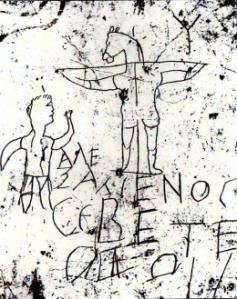
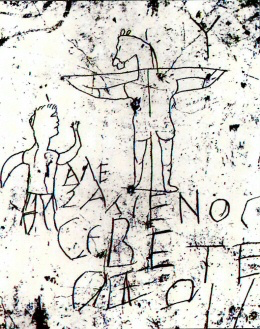
AD 200–250 image of a man kneeling before and worshipping the crucified Christ depicted as a donkey.
Earlier this afternoon I was reading along in the book of Hebrews and came across Hebrews 6:4–6:
For it is impossible, in the case of those who have once been enlightened, who have tasted the heavenly gift, and have shared in the Holy Spirit, and have tasted the goodness of the word of God and the powers of the age to come, and then have fallen away, to restore them again to repentance, since they are crucifying once again the Son of God to their own harm and holding him up to contempt.
Now, these verses are among some of the most debated passages within the New Testament. To whom does the author refer? What does it mean they have tasted the heavenly gift and shared in the Holy Spirit? While these are all pertinent and necessary questions, I have no intention of addressing any of them. Instead, I want to take a look at the word παραδειγματίζοντας, “holding him up to contempt.”
It is a well known fact that the Romans would use crucifixion as a means of not only publicly shaming the victim but as an advertisement throughout that region that Rome didn’t mess around. If you are found guilty of the same crime, the same punishment would fall upon you.
This is precisely what the word παραδειγματίζω “hold up to contempt” or “disgrace publicly” is getting at. As we look through the LXX, the Greek version of the Old Testament, we find it used in a number of places. Though crucifixion isn’t in view in these instances [[Edit: As J. K. Gayle has pointed out over at BLT, crucifixion is indeed in view in the Esther passage cited below. My apologizes for this oversight.]], the punishment that befalls these individuals is meant to serve as a warning to the larger community:
-
Num. 25:4 “And the Lord said to Moyses, “Take the chiefs of the people, and make an example of them to the Lord before the sun, and the anger of the Lord’s wrath shall be turned away from Israel.”
-
Esth. 14:11 “O Lord, do not surrender your scepter to those who don’t exist, and do not let them laugh at our downfall, but turn their plan against them, and make a public example of him who began this against us.”
-
Dan. 2:5 “Then the king said in reply to the Chaldeans, “Unless you tell me the dream with certainty and disclose its sense, you will be made an example, and your possessions will be expropriated into the royal treasury.”
In Numbers, those who were initiated into Beel-Phegor (idolatry) were to be made an example of, as was Hammond for his plot against Mordecai in Esther and the Chaldeans if they failed to interpret the king’s dreams.
On Hebrews 6:6, Guthrie writes in his NIV Application Commentary:
The language of crucifixion and public shaming is both potent and ironic. Instead of being blessed by accepting the forgiveness found in the crucified Christ, the ones who have fallen away identify with those who used the cross as an ultimate expression of rejection. Instead of being shamed in the eyes of the world by identification with the Son, “bearing the disgrace he bore” (13:13), the apostates stand with those before the cross who cast insults, disparaging Christ’s claims as the true Messiah (p. 220).
Now, I’d like to offer an inter-textual addition to this interpretation. [[Nota Bene: I’m not suggesting that the author of Hebrews is drawing upon this text or even that he had it in mind. That is to say, the following observation is not offered on the basis of the Hebrews’ awareness of Colossians or vice versa.]]
In Colossians 2:13–15 we find an interesting understanding of Christ’s crucifixion:
And you, who were dead in your trespasses and the uncircumcision of your flesh, God made alive together with him, having forgiven us all our trespasses, by canceling the record of debt that stood against us with its legal demands. This he set aside, nailing it to the cross. He disarmed the rulers and authorities and put them to open shame, by triumphing over them in him.
![Colossians 2:15 [widescreen]](https://jacobcerone.com/wp-content/uploads/2015/03/colossians-215-widescreen.png?w=300&h=169) The word used in Colossians is the uncompounded form of παραδειγματίζω and is similar to the usage found in Hebrews. Paul, in Colossians, is saying that, though the rulers and authorities intended to put Christ to public shame by crucifying him, Jesus transforms that shame into his exaltation, the forgiveness of sins, and the shame of the rulers and leaders.
The word used in Colossians is the uncompounded form of παραδειγματίζω and is similar to the usage found in Hebrews. Paul, in Colossians, is saying that, though the rulers and authorities intended to put Christ to public shame by crucifying him, Jesus transforms that shame into his exaltation, the forgiveness of sins, and the shame of the rulers and leaders.
Now, here’s a tentative suggestion I would like to offer. If the Christian community at large understood Jesus’ crucifixion as an act that transforms an inherently shameful form of capital punishment into a means of exaltation and glorification that functions as the salvation of his people, then one’s rejection of Christ after having participated in the covenant community (however one defines that in the context of Hebrews) in effect denies that Christ’s death had any transformative function. Though they once would have seen Christ’s death as a reversal of the shame it was meant to be, they are now confirming that Christ died a shameful death at the hands of the Romans and should, thus, be disgraced and regarded as no better than the criminals and seditionists that experienced a similar fate at the hands of the Roman empire.
As I noted above, these are only some preliminary thoughts based upon the similarity of the two passages and I would love to hear any input you might have.


![Colossians 2:15 [widescreen]](https://jacobcerone.com/wp-content/uploads/2015/03/colossians-215-widescreen.png)













 ἐνθύμησις