Fun in Vaticanus: A Mysterious Lamed

I am re-reading through the Greek version of Matthew 3 in order to revise one of my papers from Seminary in hopes of submitting it to the Regional meeting of the Evangelical Theological Society.  So…why not do my reading in one of the codices?  I decided on Vaticanus and began.  About fifteen minutes into my reading I came across verse three (yes…it took me that long to read three verses) and noticed something out of place in the margins.
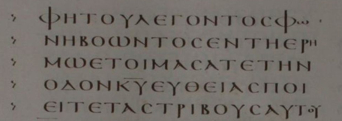
Look to the left of the main text.  Do you see a letter from a different language?  That is the Hebrew letter lamed.  Can you guess why it appears here?  Since I can’t find any information about this on the internets, I will have to share with you my unconfirmed suspicions (though I am pretty confident I am correct as I found it in several other places).  The lamed serves as a marker for quoted text, and it is most likely an abbreviation of the Hebrew participle lemor “saying.”  In this instance Matthew is citing from Isaiah.  It is important to not that the lamad only marks the lines of the text that contain a quotation.  For instance, the lines of text marked here contain part of the narrative as well as the citation: “[pro]phet saying, ‘A voice crying out in the wilderness, prepare the way of the Lord, make straight his paths.'”  Notice that the bolded text is not a part of the quotation from Isaiah, but is part of a line that contains the quotation.

But is this part of the original manuscript?  After all, Vaticanus contains versification, presumably by a modern scholar seeking to make the text “user-friendly.”  Internets…you failed me…now how will discover the answers?

Posted in NT Codices | Tagged | 1 Comment

Fun in Sinaiticus: A Nerd Experiences Abbreviations

I mentioned that I received an Accordance module of codices from the Massengills and Cerones for my birthday.  Well, yesterday I was finally able to sit down and dabble.  To my delight I found a phenomenon of which all students of textual criticism are made aware early in their careers.

The nomina sacra “sacred name.”  When the word κυριος “Lord” is used with reference to the divine, it is abbreviated as ΚΥ with a macron spanning the two letters.  You too can see this phenomenon in Codex Sinaiticus in this image.  Train your eye on the third line in the middle of the text: ΓΕΛΟCΚΥΦΑΙΝΕ.  I know that this is not a new find and may be very mundane for many, but to be given the opportunity to look at an ancient manuscript and see with my own eyes this scribal practice was nothing less than exhilarating.

Now if that was exhilarating, imagine what I felt when I found this as I was reading through Matt 2:6: ΙΗΛ.  You can see this at the very bottom right of the image.  It is the last three letters of the excerpt.  I’ve never learned the Greek word “Iel.”  That’s because this is an abbreviation for ΙCΡΑΗΛ, Ισραηλ, or Israel.  No, this is not a significant find, but I was never told to expect any abbreviations in the ancient texts other than the nomina sacra.

An aside for the attentive observer…  Sinaiticus is an Uncial text.  Uncial texts are characterized by continuous writing (no breaks in the text to differentiate where one word ends and another begins), no punctuation, and most importantly all letters are capitalized.  These features make for a very slow and interesting read.

Posted in NT Codices | Tagged | 1 Comment

The Past Few Days

I haven’t blogged in a while.  This isn’t because I haven’t had anything to say, but because I have had a flurry of events take place and the task of recounting them here on the blog has loomed overhead as a daunting task.  I will nevertheless make an attempt.

1) My ability to study during work and thus my productivity has greatly diminished.  Due to a sequence of events and an impromptu, but necessary, reorganization of my company I have had to take on the role of Operations Manager on top of my duties as a file clerk, receptionist and courier.  This means that I have little free time during the day.

2) What little free time I have had has been spent preparing for Brooke and Andrew’s wedding.  The rehearsal and the wedding went off without a hitch (ha…ha…ha…yeah…it was a pun…I know), but there were a few bumps along the way.  I have one take away for ministers who perform their first wedding…DON’T LET THAT DETAIL BE KNOWN TO THE WEDDING DIRECTOR.  There are few things worse in the world than being told “I’m sure you will do fine,” but treated as if the couple made a bad decision when choosing you.  Do your research, come in with confidence, and be humble when you are corrected.

3) The “Young Adults” crowd at Cary Alliance celebrated our annual Christmas Party.  This happened to coincide with two other occasions: our decision to leave Cary Alliance and my birthday.  Scott Hess took this opportunity to make us (and me in particular) feel loved by celebrating my birthday at the party.  Thank you Scott and thank you Cary Alliance for understanding our departure and for being adamant about maintaining fellowship with us.  You truly understand what it means to be a part of the universal body of Christ.

4) Mary Beth and I attended Cary Alliance in order to hear my mother-in-law perform Rejoice Greatly from Handel’s Messiah.  This was an indescribable experience.  Yet, the thing I keep coming back to is the fact that it is a glorious thing when the form matches the message.

5) Yesterday my side of the family celebrated my birthday and showered me with Accordance gift certificates.  Part of that money has already been spent on NT-MSS Images (facsimiles of Alexandrinus, Sinaiticus, Vaticanus, Washingtonensis, and the original Codex 2882).  This will be a real joy to learn how to read Greek without spaces, punctuation and in Uncial (all-caps) script.

Posted in Life | Leave a comment

Idioms in 1 Maccabees: Revised

Once again I opened my trusty LXX to 1 Maccabees and discovered something interesting.  I previously mentioned that the author used πιπτω as a euphemism for death.  Well, when translating, I found this expression “contrasted” with the verb θανατοω “to deprive one of life.”

Since πιπτω, in this isolated instance, was used in the context of Jews killing the oppressive Gentile forces in battle, and since θανατοω, in this isolated instance, was used in the context of Gentile forces “putting to death” the Jewish resistance, I was spurned to do a quick study within 1 Maccabees.  One lunch break later revealed disappointing results.  See, I was attempting to locate the author’s bias towards the Maccabean revolt through verb usage.  Yet πιπτω “to fall/die” seemed to be used almost as frequently regarding the death of Jewish forces as Gentile forces.  An analysis of αποκτεινω “to violently kill [regardless of intent]”  turned up the same results.

So much for easy theories.

Nevertheless, I did turn up a few interesting bits.  These nuggets haven’t been refined so they are presented here only as potential for further study.  First, πιπτω, when being used euphemistically, was almost exclusively used in the context of battle/war.  Second, θανατοω, with only one exception (6:45) is used when the Gentiles put the Jews to death.  This may be mitigated by the fact that θανατοω is almost always used in the context of legal execution.  The fact that Antiochus Epiphanes ordered the execution of any in violation of his decrees causes one to pause before making rash judgments about the verbs usage.

Posted in LXX | Tagged | Leave a comment

Idioms in 1 Maccabees

As you might be aware, I have been doing a bit of translation in the first book of Maccabees. I have noticed a couple of idioms that I would like to share.

The first is the tendency for the author to utilize a euphemism for death. Instead of using the common word αποκτεινω “to kill,” the author chooses πιπτω “to fall.”. For some reason the KJVA (King James Version Apocrypha) does not acknowledge the euphemism and translates it “they were slain.”

Second, while verbs must agree with there subjects in person and number, there is a common exception I have found in both biblical and non-biblical Greek. Here is an example Εἶπεν δὲ Ιουδας καὶ οἱ ἀδελφοὶ αὐτοῦ. This phrase reads, “and Judas said, and his brothers…”. This entire phrase is the subject of the sentence, “Judas and his brothers.”. Yet, it is almost as if “his brothers” is an afterthought as the verb is 3rd singular instead of 3rd plural. This happens to be a common occurrence throughout Greek texts.

Posted in LXX | Tagged | Leave a comment

A Long Weekend

Some of you might be wondering, “Why no new posts?”  Well…as the title of this post suggests, it has been a long weekend.

Friday and Saturday were filled with work Christmas parties.  I guess the benefit of being outsourced labor is that you get to go to two Christmas parties.

Saturday evening was spent with the Massengill clan.  They treated us to a delicious meal, provided doggie socialization, and graciously celebrated my birthday.

Sunday was spent at my parents for brunch.  The rest of the day was consumed by painting shutters.  One coat has been applied…not to find some time within this coming week to apply a second (and maybe third) coat, reinstall them, take pictures of the work done, and finally get my bank to release our settlement check from the tornado damage.

Things to do:

  1. Finish preparing my sermon for Andrew and Brooke’s Wedding.
  2. Attend and facilitate the wedding rehearsal and the rehearsal dinner.
  3. Officiate at my first wedding.
  4. Finish Christmas shopping
  5. Decide which Accordance modules will best serve my future studies.
Posted in Life | Leave a comment

ein Weihnachtsbaum

<–Das ist unser Weihnactsbaum.  It is the first year together we have had a real Christmas tree.    It is the first year I have ever owned a real tree.  For those of you who have never owned a real tree, and for the entertainment of those who have, I offer a few pieces of advice.  1) In order to get the tree to fit in its stand you must cut off the bottom branches.  2) Not owning a handsaw is not a good enough reason to use a hatchet in order to cut those branches off.  Several misplaced shots, a floor full of fallen needles, and one small but noticeable gash in the linoleum  later it came to me that pruning sheers would have done the job far more efficiently.  But hey, this is the price you pay for trying to make your wife happy…and do so quickly (see, I just blamed it on my wife even though this whole ordeal is due to my own lack of patience).  3)_________________________ (this blank is reserved for the destruction that will ensue due to the potential for Jazz (our Jack Russell Terrier) to be a terror.

I have also learned a bit about the power of tradition.  December has been a bit overwhelming for the Cerone family, and we came very close to not putting up a Christmas tree this year.  Mary Beth came right out and said, “I don’t see a point in doing it…it’s already so late in the season.”  But I could see how much she really wanted one.  It has nothing to do with “the Christmas spirit” or materialism.  Traditions can be a beautiful thing.  They make us feel comfortable.  Breaking with tradition can leave a deep uneasiness.  It makes us feel as if we are “not at home.”  It has always been fascinating to me how powerful symbols and tradition can be.

Posted in Life | Tagged | Leave a comment

Coffee Mug Quote of the Day

Today’s, and yesterday’s for that matter, quote of the day is “Der Zeit ist jetzt”  Translation?  “The time is now.”  The time for what?  It is time to start making serious headway in my academic development.  It is time to learn German; to seek out classes in German, German tutors, and to start researching the Septuagint through German articles and studies.  I am not getting any younger and it is not as growing older has increased my capacity for learning.  The time is now to press on to those things I have shied away from out of fear of failure.  The time is now to “…throw off everything that hinders and the sin that so easily entangles, and let us run with perseverance the race marked out for us” (Heb 12:1).  For me this sin is squandered time (movies, tv, and sheer laziness).  The time is now for me to give myself and my time freely to God, my wife and family and my studies.

Posted in Life | Tagged | Leave a comment

Rembrandt and Higher Criticism

This weekend I have attempted to lavish Mary Beth with my time.  Last night we met at Remington Grill before going to watch “Rise of the Planet of the Apes” at the $1.50 theater, which is now the $2 theater…just doesn’t have the same ring to it.
This morning we went to see the “Rembrandt in America” exhibit.  This excursion was entirely planned by me without her knowledge.  It was an attempt to make up for my negligence last year (I promised to take her to see Picasso last year but allowed my studies to overtake me and the days simply slipped by).

We were both taken a back by his mastery of lighting and his ability to paint in such a way that conveys intimacy.  When standing in front of some of these paintings, the viewer felt as if he knew the subject.  We were also fascinated that a great deal of controversy surrounds the authentication of a Rembrandt painting.  The formation of the Rembrandt Research Project in 1968 led to the de-authentication of at least 200 “Rembrandts” among a oeuvre of over 400 paintings.  That is to say that over half of the paintings thought to be painted by Rembrandt were not painted by his hand.

This number can be explained in part by two common practices at the time.  First, teachers had the right to sign their students art as their own and sell the painting.  This practice is paralleled in modern scholarship when a) a student does all the research for his major professor and receives little to no credit for his labors and b) when an individual new in the scholarly world writes almost all of a “collaborative” work.  Second, it was common for Rembrandt to work on a collaborative painting with one of his students.  This leads to confusion in analyzing the final product, which possesses Rembrandt’s techniques at points but diverges at other points.

Despite these explanations, we still came away with the impression that determining whether a work was of Rembrandt of one within his guild was a rather subjective task.  Many of the times it simply came down to “it isn’t good enough” or “this painting does not express the typical genius of a Rembrandt.”

Now to the point: It simply amazed me that the Rembrandt historians are so unsure as to whether a painting came from his hand or that of another, while biblical scholars are rather adamant that 1 & 2 Timothy, Hebrews, and Ephesians did not come from the hand of the Apostle Paul.  Rembrandt scholars have a corpus of 200 authentic works to establish a base line.  The Pauline corpus is ~6% of that size.  I know that the comparison breaks down.  We are dealing with two different forms of media, different means of analysis and authentication, different circumstances, and the fact that painters that might own a possible “fake” have a monetary interest in the piece.  Nevertheless, it makes one wonder about the reliability of internal evidence (style, word choice, literary devices, etc), especially when external evidence is shunned outright (testimony of the early church).

Posted in Life | 1 Comment

German Genesis

I came across this in my German drills and was tickled to death that I could read it:

Das erste Buch Moses beginntL ,,Am Anfang schuf Gott Himmel und Erde.  Und die Erde war wüst und leer, und es war finster auf der Tiefe; und der Geist Gottes schwebte auf dem Wasser.  Und Gott sprach: Es werde Licht! Und es ward Licht.  Und Gott sah, daß das Licht gut war.  Da schied Gott das Licht von der Finsternis und nannte das Licht Tag und die Finsternis Nacht.  Da ward aus Abend und Morgen der erste Tag.”

Posted in Uncategorized | 1 Comment