April Carnival

chicago09_1024x768

It’s time for another carnival. Though it is a meager one, I hope that you will get your fill of fun and revelry.

Hermeneutics

Matt Emerson has an excellent series on the various methods of biblical exegesis. Emerson provides a snapshot of his Method and follows that post up with a look at the constituent parts of the method in these posts: Christocentric MethodPneumatological Method,  Canonical Method, and Narrative Method.

Biblical Studies

John Himes guess-posts over at Paroikos Bible Blog. He asks “What Shall We Do with Those Idioms?” What is an idiom? How should translators handle idioms? Four options are open to translators: 1) “literal” translation that creates the same idiom in the target language, 2) from idiom to nonidiom, 3) from idiom to idiom, and 4) from nonidiom to idiom.

Mark Goodacre has asked an excellent question about the role of blogs in the world of scholarship in his post: Peer-reviewed article responding to a blog post: what is the etiquette?

Old Testament

Andrew King, over at “The Blog of the Twelve,” writes about the The Literary Function of the Remnant Motif in Isaiah’s Royal Narrative as an “indicator of the monarchial climate in Judah.”

James Pate has posted an excellent overview of the problematic passage Deuteronomy 24:4: Why Was the Ex-Wife Defiled? In this article, Pate summarizes the solutions of 7 different commentators while offering his thoughts along the way.

Bob MacDonald continues his series on Bervard Childs’ The Struggle to understand Isaiah as Christian Scripture as well as his series Memorizing the Psalms.

An atheist explores text critical issues related to the David and Goliath narratives found in 1Sam 17; 2Sam 21:19; 1Chr 20:5 in his series “Who Killed Goliath?” This is part 4 of an ongoing series that chart the textual affinities shared between these passages in the Hebrew and Old Greek versions.

New Testament

Jordan Burt, a student of James McGrath provides the definitive explanation for the peculiar inclusion of “153 fish” in John 21 here. While you are over at Patheos, stay a spell. McGrath, in his post Is Historical Jesus Research Futile, entreats us to not throw out the baby with the bathwater; historical Jesus research is both helpful and necessary despite some of the eccentricities often characteristic of this field of study.

Though David Black’s New Testament Greek Portal is neither specific to the month of April nor a blog, per se, it is a regularly updated annotated bibliography of the all things pertaining to New Testament Greek online.

Dan Wallace shares an interview he had with Katherine Weber of the Christian Post concerning The Authenticity of the Gospel of Judas.

Theology

Consider yourself forewarned, Adam Parker connects Jonathan Edwards’ theory of original sin with the new movie Oblivion in his spoiler of a post Jonathan Edwards, Co-Writer of Oblivion.

Early Christianity

Larry Hurtado talks about his recent lectures in the States in these three posts: “Revelatory” Experiences and Religious Innovation, “Early Christian Monotheism”, and Jesus in Early Christian Prayer.

Art and the Bible

Victoria Jones’ post Homeless Jesus sculpture finds a home, over at “The Jesus Question,” interacts with Timothy P. Schmalz’s artistic interpretation of Matthew 25 as a resident of Cambridge Massachusetts. While we’re on the subject, Michele Stopera Freyhauf  asks “Why are We Troubled by a Homeless Jesus“.

Book Reviews

Next month’s Carnival will be hosted by Jeff Carter. Make sure to visit his blog That Jeff Carter Was Here, and send him whatever links you think should be in the May Carnival.

Posted in Biblical Studies | Tagged | 5 Comments

Septuagint Jonah 1:1-3 and 3:1-3 Compared

Here is another snippet from my paper on the information structure of Septuagint Jonah. This part belongs in my discussion of the book’s macrostructure. Enjoy! [As a side note: I apologize in advance for the formatting of the Greek text. If you thought formatting in Word was difficult, it is virtually impossible in WordPress]

The book of Jonah is built around two parallel halves. Each half is introduced with nearly identical background material: the word of the Lord, Jonah’s commissioning, and Jonah’s response. These similarities are illustrated below for comparison:

  • 1:1 Καὶ ἐγένετο λόγος    κυρίου        πρὸς Ιωναν τὸν τοῦ Αμαθι        λέγων
  • 1:1 And was      a-word  of-the-Lord  to Jonah    the son of-Amathi saying,
  • 3:1 Καὶ ἐγένετο λόγος    κυρίου         πρὸς Ιωναν ἐκ δευτέρου            λέγων
  • 3:1 And was      a-word of-the-Lord   to Jonah      for a-second-time  saying,
  • 1:2a Ανάστηθι καὶ   πορεύθητι   εἰς  Νινευη  τὴν πόλιν τὴν μεγάλην καὶ κήρυξον ἐν αὐτῇ,
  • 1:2a Arise        and  go               into Nineveh the city    the  great       and preach   in   it,
  • 1:2b ὅτι          ἀνέβη   ἡ   κραυγὴ τῆς      κακίας αὐτῆς πρός με.
  • 1:2b because  arose    the cry        of-the  evil      of-it   to      me
  • 3:2a Ανάστηθι καὶ   πορεύθητι   εἰς  Νινευη  τὴν πόλιν τὴν μεγάλην καὶ κήρυξον ἐν αὐτῇ,
  • 3:2a Arise        and  go               into Nineveh the city    the  great       and preach   in   it,
  • 3:2b κατὰ                 τὸ  κήρυγμα        τὸ ἔμπροσθεν, ὃ         ἐγὼ ἐλάλησα πρὸς σέ.
  • 3:2b according to     the proclamation the former,    which  I      spoke      to     you.
  • 1:3 καὶ   ἀνέστη Ιωνας   τοῦ φυγεῖν         εἰς Θαρσις ἐκ      προσώπου   κυρίου . . .
  • 1:3 And arose     Jonah   in-order-to-flee  to  Tharsis from  face             of-the-Lord
  • 3:3 καὶ ἀνέστη Ιωνας    καὶ ἐπορεύθη      εἰς Νινευη, καθὼς ἐλάλησεν κύριος
  • 3:3 And arose   Jonah   and he went       to Nineveh, just as the Lord said.

Jonah 3:1-3 is virtually identical to 1:1-3 with the exception of a few ancillary elements. A segment of verse two, though, ties these passages even closer together in a way that the Hebrew text does not. The addition of ἔμπροσθεν, “former,” and the translation of the periphrastic participial construction דֹּבֵר  אָנֹכִי, “I am saying,” with ἐγὼ ἐλάλησα, “I said,” leaves no doubt in the reader’s mind that the word of the Lord that came to Jonah in chapter one is identical to the word that Jonah receives in chapter three.[1] These minor alterations in the Septuagint text add a greater degree of cohesion between chapters one and three. The message Jonah must deliver has not changed. Has Jonah changed? Will he deliver God’s message?


[1] Larry Perkins, “The Septuagint of Jonah,” 44-5, writes, “in this context the LXX adds the expression (τὸ κήρυγμα) τὸ ἔμπροσθεν “the former proclamation” and uses the verb ἐλάλησα, “I spoke” making it quite clear that this oracle is not a new statement but the repetition of the original one given in 1:2. The content of that oracle has not changed nor, presumably, have any of the time constraints included in it. The MT suggests that Yahweh provides a new oracle to Jonah, not necessarily the exact duplicate of the original.”

Posted in Biblical Studies, Jonah, LXX, Old Testament Studies | Tagged | Leave a comment

Directionality in Jonah

The book of Jonah plays with the concept of directionality. God’s command to arise, “ἀνάστηθι,” is paired with Jonah’s initial complicity in 1:3a, “ἀνέστη,” “and he arose.” This is contrasted with Jonah’s downward movement. He goes down, “κατέβη,” into Joppa (1:3b), and then he makes a lateral move as he embarks, “ἐνέβη,”on a ship going to Tarshish (1:3e).

The translator’s sensitivity to the narrative’s geographical setting leads him to translate וַיֵּרֶד, “he went down,” with ἐνέβη, “he embarked.” The rendering τοῦ πλεῦσαι, “in order to sail,” for לָבוֹא, “in order to go,” reinforces this. Though the change weakens the original Hebrew connection between קוּם, “arise,” and the repetition of וַיֵּרֶד, “he went down,” it does not destroy it since both words, κατέβη and ἐνέβη, are built upon the same root, βαίνω. Though the connection between the two words is tenuous, the observant reader is able to make the connection.

This is not true in 1:5f, where the Hebrew וַיֵּרָדַם, “and he slept soundly,” is translated with ἔρρεγχε, “he snored.” The play on words between יָרַד, “he went down,” and רָדַם, “he slept soundly,” is not communicated in the Greek text. John Beck writes,

“The root קוּם is consistently represented by a form of ἀνιστήμι. But the descent of Jonah that is evident in the Hebrew narrative from the time he heads for the seaport is translated by three different roots: καταβαίνω, ἐνβαίνω, ἐρρέγχω. Again an important tool in the characterization of the Hebrew Jonah is lost”.[1]

Characterization is indeed lost. The original author of Jonah uses this Leitwort not only to communicate Jonah’s geographical distance from God, but also to emphasize Jonah’s deliberate disobedience with each move he makes. Jonah will go to whatever depths necessary to get away from God and not escape his commission to deliver God’s message to Nineveh.

Whether or not it was a conscious decision, the translator has developed the geographic setting of the narrative at the expense of a robust characterization of Jonah. This fact becomes more important as the narrative unwinds. Jonah’s request to be thrown overboard is not a selfless act of sacrifice (his life for the sailors). Instead, it is  another attempt, in a long sequence of events, to get away from Yahweh. He is prepared to die. In fact, he goes down to Sheol, where the Lord preserves him, hears his cry, and delivers him.


[1] Translators as Storytellers: A Study in Septuagint Translation Technique, Studies in Biblical Literature 25, (New York: Peter Lang, 2000), 119

Posted in Jonah, LXX | Leave a comment

Jonah and Nineveh or Nineveh and Sodom

Here is a footnote [and by footnote, I mean a full page that will probably get cut out but saved for a more relevant paper] from my forthcoming paper [and by forthcoming, I just mean my term paper] on the Septuagint version of the book of Jonah.

In the Hebrew text, Jonah’s act of flight מִלִּפְנֵ֖י יְהוָֽה,“from before the Lord” (1:3a,e), is linked to Nineveh’s evil, which comes up לְפָנָֽי, “before me” (1:2c). The Hebrew provides a clue for the reader to consider. Jonah’s act of flight will not escape the attention of his God in the same was that Nineveh’s evil has not escaped his sight. This subtle connection is broken in the Septuagint as Jonah is seen fleeing ἐκ προσώπου κυρίου, “from before the Lord,” and the cry of evil comes up πρός με, “to me.” Admittedly the difference in preposition is minor, but in a book that relies heavily on lexical repetition (not just repetition of words within the same semantic field) such an alteration is noticed.

This change, though, does not appear to be for varieties’ sake. The translator appears to have made an intentional intertextual link. The clause ὅτι ἀνέβη ἡ κραυγ τῆς κακίας αὐτῆς πρός με, “because the outcry of its evil has come up to me,” appears to be an interpretive translation that connects Nineveh to the Sodom and Gomorrah narrative found in Genesis 18. Sasson writes, “The Greek versions offer paraphrases (for example, LXX: ‘for the cry of its wickedness has come up to me’), some of which are obviously influenced by the Sodom narrative of Genesis” Jonah, The Anchor Yale Bible, (Yale University Press: New Haven, 1990), 76-7. The Septuagint version of Genesis 18:20-21 reads, “εἶπεν δὲ κύριος Κραυγ Σοδομων καὶ Γομορρας πεπλήθυνται, καὶ αἱ ἁμαρτίαι αὐτῶν μεγάλαι σφόδρα·  καταβὰς οὖν ὄψομαι εἰ κατὰ τὴν κραυγν αὐτῶν τὴν ἐρχομένην πρός με συντελοῦνται, εἰ δὲ μή, ἵνα γνῶ,” “And the Lord said, ‘The outcry of Sodom and Gomorrah has multiplied, and their sins are exceedingly great. When I go down, then, I will see if they are acting according to the their outcry which is coming to me.”

If this connection can be made with any confidence, then the reader is meant to read the wickedness of Nineveh and God’s just condemnation of the city in concert with his former condemnation of Sodom. Furthermore, whether intentionally or unintentionally, the translator has also strengthened the condemnation of Jonah’s actions. He has taken a subtle point about the inability of Jonah and his rebellion to escape the eye of God made by the author’s repetition of לְפָנָֽי, and turned it into an implicit comparison between the actions of Jonah and Abraham. Abraham begs God to relent from the disaster he has planned for Sodom. Jonah refuses his calling because he knows God will be compassionate and will relent from the condemnation and destruction of Nineveh.

Posted in Greek, Jonah, LXX | Tagged , , , | 2 Comments

The Travesty of Translation

Okay, the title of this post might be overstating my case a bit, but I find myself growing ever so weary of Septuagint Jonah’s translator. Overall he does a rather fine job. But some of the literary artistry is destroyed in the name of lexical diversity and/or specificity. Allow me to explain…

The Hebrew version of Jonah, through lexical repetition, creates a rather intriguing role reversal in the first chapter of the book. God commands Jonah to “rise and go to Nineveh.” Upon arrival he is to “call out against it.”

קוּם לֵ֧ךְ . . . וּקְרָ֣א עָלֶ֑יהָ

 Jonah, as I’m sure you know, did not go. Instead, he “arose” in order to “flee” to Tarshish. The Septuagint translator renders this section

Ανάστηθι καὶ πορεύθητι εἰς Νινευη . . . καὶ κήρυξον ἐν αὐτῇ

At first look, this is a perfectly acceptable translation. As a matter of fact, the translator indicates his understanding of the context. Right? Instead of translating קרא “*καλέω,” he recognizes the religious implications of Jonah’s actions. He is κηρύσσειν “t0 proclaim/preach.” The Greek rendering is altogether appropriate considering his prophetic role (see Johann Lust’s Septuagint Lexicon).

Where, then, is the issue? As the narrative progresses, we find an irresponsive Jonah. God sends a great storm. The sailors are panicked. Jonah does not care. He does not assist the soldiers to lighten the ship. He does not offer prayers or petitions for his life or the lives of his fellow shipmates. Instead, he goes into the innermost part of the ship and falls asleep.

After all their efforts have failed, the captain of the ship approaches Jonah and exhorts him. The Hebrew text reads:

 קוּ֚ם קְרָ֣א אֶל־אֱלֹהֶ֔יךָ

“Arise, call out to your God”

The Greek text reads:

ἀνάστα καὶ ἐπικαλοῦ τὸν θεόν σου,

“Arise and call out/invoke your God.”

Granted, the distinction is small. But that small distinction makes all the difference. By using the κηρύσσω word group, he has translated himself into a corner. He cannot translate this section ἀνάστα καὶ κήρυξον πρὸς τὸν θεόν σου. Preaching or issuing a proclamation to God makes little to no sense. The translator is forced to translate קרא how he should have, in my opinion, translated it to begin with (with the *καλέω word group).

As the Septuagint text stands, the role reversal is all but destroyed. The repetition of קרא in the Hebrew original allowed us to make a connection between the roles of Jonah and the captain. Jonah is commanded by God to “arise and call out.” He is sleeping silently. The captain is the one who is calling out to Jonah. He tells him none other than what God has previously told him “arise and call out.” It as if the pagan captain has assumed the role of the prophet, and Jonah has taken the place of the pagan.

This characterization is further supported by the various strands of the narrative. Jonah has all the right knowledge about God, but he is irresponsive. He does not care about the lives of his shipmates. They show the utmost concern for his. Though the sailors do not initially know the God of “the sea” and “dry land,” they “pray,” “sacrifice sacrifices,” and “vow vows” in response to Jonah’s creedal confession.

The good news, in all this, is the fact that the translation of קרא in chapter three remains consistent throughout (κηρύσσω is used). The only instance of inconsistency regarding this specific instance of lexical repetition occurred in 1:6.

This forces us to answer a couple questions?

First, is the contextual rendering of קרא with κηρύσσω worth the cost? Translators have to make these decisions every time they approach the text. Often times the choice is more complex than the above instance. Words in the target language rarely, if ever, have exactly the same semantic range as to source language.

Second, how much has really been lost in this instance and others like it? At the very least I believe that the Hebrew propensity for lexical repetition as a means of creating meaning is lost. Yet, has the role reversal been altogether destroyed? ἐπικαλέω “to call upon” and κηρύσσω “to preach” are similarly related. But would the observant reader be able to make the connection without having it explicitly made for him through lexical repetition? Or must we have that repetition in order to make any confident claim about meaning?

Sound off in the comments section if you have any thoughts. There are countless instances just like this throughout the LXX edition of Jonah, and your thoughts would be appreciated as I work through it!

Posted in Biblical Studies, Discourse Analysis, Greek, Hebrew, LXX, Old Testament Studies | Tagged , | Leave a comment

The Septuagint and Ezekiel 4:12-13

Tonight in my seminar on the Prophets we covered Ezekiel chapter 4. There there were many things I found of interest in this passage, I want to hone in on verses 12-13.

Before we get there, let me give you a bit of context as to where we are at in the book of Ezekiel. Ezekiel has seen a vision of the glory of God atop a chariot which moves about by four living creatures with four wings and four faces, as well as four wheels which have wheels within them. After seeing this vision, Ezekiel is commanded to prophesy against the house of Israel. Ezekiel’s prophesy takes a number of forms. One form of Ezekiel’s prophecy manifests itself in physical signs wherein he acts out the calamity Israel will experience at the hand of her God.

Chapter four contains two different signs. In the first sign, Ezekiel inscribes the city of Israel on a brick. On that same brick he depicts seize engines that are erected against the city. He is commanded to lay bound on his left side on the brick? for 390 days for the iniquity of Israel and 40 days on his right side for the iniquity of Judah.

The second sign is a bit more bizarre and colorful. Ezekiel is commanded to throw a bunch of ingredients together and make barley cakes. These cakes are to be baked over human dung. For those unfamiliar with the Levitical purity laws, or with any sense of human decency and or hygiene, you will know that doing this would make ritually unclean (unpresentable to God). With this background in mind, let’s take a look at Ezekiel 4:12-13.

The Hebrew text reads:

וְעֻגַת שְעֹרִים תֹּאכֲלֶנָּה וְהִיא בְּגֶלְלֵי צֵאַת הָאָדָם תְּעֻגֶנָה לְעֵינֵיהֶם

וַיֹּאמֶר יְהוָה כָּכָה יֹאכְלוּ בְנֵי יִשרָאֵל אֶת לַחְמָם טָמֵא בַּגּוֹיִם אֲשֶר אַדִּיחֵם שָם

“And you will eat it as a cake of barley. And you will bake it on human dung before their eyes.”

“And the Lord said, ‘In this way the sons of Israel will eat their unclean bread among the nations where I drive them them there.”

Notice a few things about this text before we move to the Septuagint translator’s rendering:

  1. The dung is not actually eaten; it is the fuel for the baking.
  2. Despite the fact that he is not commanded to eat the dung, the food becomes unclean.
  3. Though the bread itself becomes unclean through the process of baking, the emphasis seems to be on the means by which it becomes unclean.
  4. There is a repetition of the phrase לַחְמָם “their bread” in 4:12 and 4:13, which is also present in 4:9 (the beginning of this sign unit).
  5. These factors all contribute to a tightly woven symbol: Ezekiel’s act of eating tainted/unclean bread is analogous to the fact that the “sons of Israel” will eat unclean bread among the nations (in exile).

Now, let us turn to the text of the Septuagint.

καὶ ἐγκρυφίαν κρίθινον φάγεσαι αὐτά· ἐν βολβίτοις κόπρου ἀνθρωπίνης ἐγκρύψεις αὐτὰ κατ᾿ ὀφθαλμοὺς αὐτῶν

καὶ ἐρεῖς Τάδε λέγει κύριος ὁ θεὸς τοῦ Ισραηλ Οὕτως φάγονται οἱ υἱοὶ Ισραηλ ἀκάθαρτα ἐν τοῖς ἔθνεσιν.

“And you will eat them as ash-baked barley cakes. You will cover them in human dung before their eyes.”

“And you will say, thus says the Lord God of Israel. In this manner the sons of Israel will eat among the nations.”

Notice anything different? Yes, the translator expands the beginning of verse three (he adds καὶ ἐρεῖς Τάδε . . . ὁ θεὸς “And you will say, thus . . . God). He also truncates the end of the same verse (אֲשֶר אַדִּיחֵם שָם “where I will drive them there”). While these are significant features, something more significant is at work here.

  1. ἐγκρύψεις “you will cover” translates תְּעֻגֶנָה “you will bake.” The dung has been transformed from the fuel for baking into a constituent of the barley cake itself.[1]
  2. The phrase לַחְמָם “their bread” in v. 13 has been omitted. Instead of reading “their unclean bread” the Septuagint reads ἀκάθαρτα “unclean things” Though the conceptual link with vv. 9 and 12 remain, the lexical link is broken. This allows ἀκάθαρτα “unclean things” to serve as a general reference to any unclean food categorized as such by Torah.

What all does this mean? In terms of deep structure, very little. That is to say, both the Hebrew and Greek texts communicate basically the same idea. Ezekiel is to serve as a symbol to the people of Israel. Just as he eats unclean bread, so also will Israel.

Yet, the surface structure of the Septuagint adds a different flavor to the overall discourse. Where the Hebrew text retains a tightly formed symbol between Ezekiel and “the sons of Israel” through the repetition of  לַחְמָם “their bread” (vv. 9, 12, 13), the Septuagint translator puts the barley cakes on a lower shelf. He decides that it is better to forgo the tightly woven symbolism in order to spell out the implications it has for Israel. It is not simply bread cooked in/with/on human dung that Israel will eat. The nation will eat all manner of foods that are deemed unclean by God.

I am always fascinated by the choices the Septuagint translator makes. We always finds it easy to criticize our translators of our English Bibles. And we should. We should always keep them honest. But at the same time, we must not be naïve. Translation must be sensitive to the complexities of nuance present in the source language. Something will also be lost in translation, but we must be ever cognizant of the choices we make.

_____________________________________

1 I admit that the manner in which the bread is prepared may be a factor here. The translators of the NETS translate this as “ash-baked” barley cakes. If this is true, it is not so much that the human excrement is a garnish on top of the bread as it is still the way in which it is made.

Posted in LXX, Old Testament Studies | Tagged , | 3 Comments

An Afternoon Date

This afternoon Mary Beth and I took a little time out of the day for ourselves. We went up to Chapel Hill to one our favorite places in the area: The Bookshop.2012-04-19_19-20-01_125

A better selection of used books at a good price you will not find. Mary Beth likes to peruse the Mystery section. She picked up a couple of volumes by Agatha Christie. Can you guess where yours truly migrated? I found my way to the Linguistics section, the Religion section, and the Classic.

Sadly, I didn’t find anything helpful in the Linguistics department. There were a couple of books by Chomsky, but currently I’m in the market for stuff explicitly on Discourse Analysis/Text Linguistics.

I did, on the other hand, find a couple of nice volumes in the Religion/Greek sections. There were a number of old copies of the Nestle Greek New Testament. No, I didn’t leave an author/editor out. These were dated before Aland got involved. As much as I wanted to, I just couldn’t justify the cost/space.

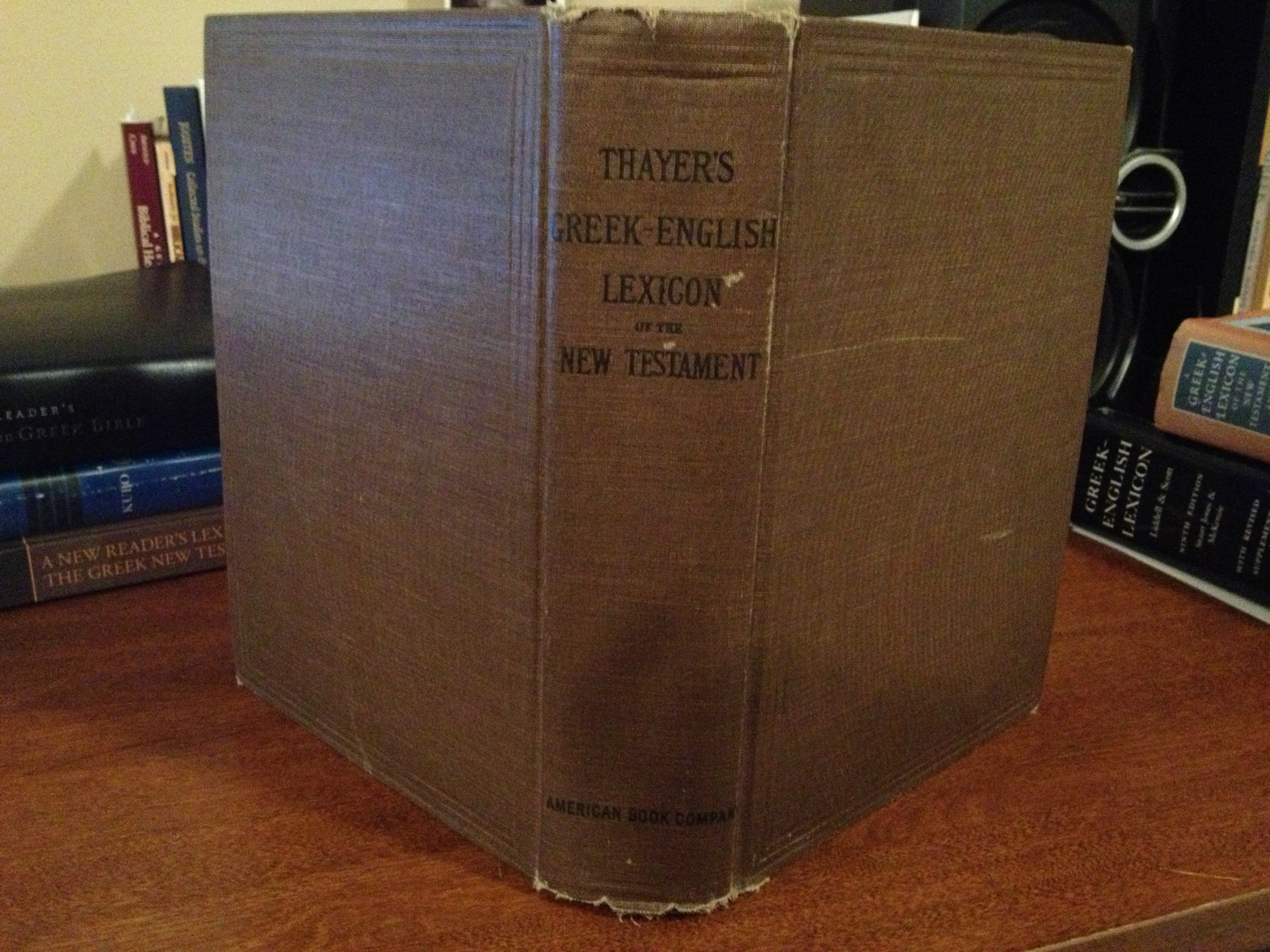
I’m not sure how I justified the cost/space for an old copy of Thayer’s Greek-English Lexicon of the New Testament.photo

[Here’s a shot of the outside]photo-1

[Here is a look at the title page]

I am aware of the fact that Thayer’s work has been superseded by BDAG. I also know that Thayer is largely regarded as obsolete due to that fact that it was written before the discovery of the papyri. Yet, this is the 1889 edition. There’s just something about an old book.

After we finished our book shopping, we migrated to the no longer called Red Bicycle –now under new management and called The Market Street Cafe. Here’s Mary Beth reading her Agatha Christie short stories.

photo-2

There is nothing like a cozy comfy coffee shop with good company and a good book. And no. I wasn’t reading Thayer. I knocked a third of Longacre’s The Grammar of Discourse.

And to top off an already enjoyable day with my lovely wife, I smell the scent of home cooked Daal wafting into my office. I would steal a bit before bed tonight, but I’m afraid the lentils won’t be done cooking until tomorrow morning.

Thank for a wonderful day and a meal to look forward to tomorrow love!

Posted in Life | Tagged , , , , | Leave a comment

Dogmatics as an Act of Prayer

I pray that you will indulge me as I quote Barth again. I think that this might be a become a bit of a habit. I told Mary Beth this evening that there are some authors that you just can’t quote. Barth is one of them, but not for reasons you might think. Barth is difficult to quote because you never stop. I am only 25 pages into the first volume and I have wanted to post something here from every page. Nevertheless, I won’t pass up the opportunity to share, even if it means you get a bit bored.

The following is taken from the conclusion of the first chapter on “The Task of Dogmatics.” Barth writes,

We maintain that humanly speaking there is nothing to alleviate the difficulty. We simply confess the mystery which underlies it, and we merely repeat the statement that dogmatics is possible only as an act of faith, when we point to prayer as the attitude without which there can be no dogmatic work.

Prayer can be the recognition that we accomplish nothing by our intentions, even though they be intentions to pray. Prayer can be the expression of our human willing of the will of God. Prayer can signify that for good or evil man justifies God and not himself. Prayer can be the human answer to the divine hearing already granted, the epitome of the true faith which we cannot assume of ourselves. We do not speak of true prayer if we say ‘must’ instead of ‘can.’ According to Rom. 8:26f the way from ‘can’ to ‘must’ is wrapped in the mystery at the gates of which we here stand. With this reference we do not give anyone a means by which he can count on succeeding in his work. It must be said, however, that it is hard to see how else there can be successes in this work but on the basis of divine correspondence to this human attitude: ‘Lord, I believe; help thou mine unbelief.’

-Church Dogmatics, The Doctrine of the Word of God I.1, p 23-24

Posted in Quotes | Tagged , , | 4 Comments

Dogmatics as an Act of Faith

Here is a sobering quote of the evening/morning. Barth writes,

Our comment is that, so long as we understand by Christianity the creaturely and cultural reality of a view of life and the world alongside Platonism, Aristotelianism, etc., and so long as we understand by a form or picture of Christianity the representation of it in its creatureliness according to the laws of the knowledge of such a reality, then the construction of an impressive form of Christianity without believing in it for better or for worse is certainly an attractive and rewarding possibility. But there can be no question of this on dogmatics. In dogmatics Christianity means the proper content of talk about God ventured in the fear of God.”

Sobering words indeed. Earlier in the chapter, Barth argues that the study of God is to be done within the context of the living body of Christ. Here he goes even further. The study of God must be rooted in and grow out of the fear of God. Even more sobering is the reality that a proper fear of God is borne out of encounter with God. How many of us engage in dogmatics, or proper talk about God, as Barth defines it?

Posted in Quotes, Uncategorized | Leave a comment

Can Clausal Analysis Solve a Textual Issue in Ezekiel 3:5?

In the grand scheme of textual issues in the Hebrew Bible, Ezekiel 3:5 would be one of those passages that would go unnoticed. And for good reason. The passage reads (according to Masoretic punctuation)  כִּי לֹא אֶל–עַם עִמְקֵי שָׂפָה וְכִבְדֵי לָשׁוֹן אַתָּה שָׁלוּחַ אֶל–בֵּית יִשְׂרָאֵל “for not to a people deep of lip and heavy of tongue you are sent, to the house of Israel.” The editors of the Biblia Hebraica Stuttgartensia suppose that the last prepositional phrase “to the house of Israel” is an addition to the text.

This supposition is offered presumably due to the inherent difficulties of the text in its current construction, though Leslie Allen believes it to be a marginal gloss. [1] As the text stands, there are two verbless clauses that span from verses 5 and 6. The English translation of these verses is as follows:

For not to a people deep of lip and heavy of tongue you are sent, to the house of Israel. Not to many peoples deep of lip and heavy of tongue, whose words you do not understand. Surely, if I sent you to them, they would listen to you.

While eliminating the phrase “to the house of Israel” reduces the difficulty of the text, this option is not attested by the versions. BHS offers no evidence for the alternative reading. The Göttingen Septuagint has no variant reading for πρὸς τὸν οἶκον τοῦ Ἰσραηλ “to the house of Israel.” The Vulgate and the Targums are also unanimous in their attestation of the phrase. It seems more likely, on the basis of the textual evidence and the principle of the more difficult reading, that the phrase “to the house of Israel” should remain in the text.

How, then, are we to understand the grammatical difficulties posed by the two verbless clauses?

Option 1: The verbal phrase אַתָּח שָׁלוּחַ “you are sent” has elided in the subsequent clauses. An English representation of this option looks like this:

For not to a people deep of lip and heavy of tongue you are sent, [you are sent]to the house of Israel. Not to many peoples obscure of speech and heavy of tongue [you are sent].

Option 2: The verbal phrase אַתָּח שָׁלוּחַ “you are sent” does double duty for the two clauses. Daniel Block writes, “Without the inserted conjunction ‘to the house of Israel’ is abrupt. But ‘atta saluah probably does double duty, functioning as the fulcrum between negative and positive prepositional phrases” (emphasis mine). [2]  

Block’s proposal is appealing. He recognizes that the two prepositional phrases are closely related. The absence of an intervening contrastive conjunction binds the two clauses together. The fact that the clauses share the same verb, strengthens that tie. The resultant translation is as follows:

For not to a people deep of lip and heavy of tongue, you are sent, to the house of Israel. Not to many peoples obscure of speech and heavy of tongue.

Notice in this translation there are two commas surrounding the verbal phrase. The second comma indicates that the verb belongs with the first prepositional phrase. The first comma indicates that the verbal phrase also belongs to the second prepositional phrase.

Appealing though this solution may be, it doesn’t address the absence of the verb in the third phrase. Has it elided? If so, why not go with the easier option 1? I believe that a third option that uses a clausal analysis to discern the underlying structure provides a better solution.

Option 3: The atnach (the Masoretic symbol indicating a break between clauses) should be placed before the verbal phrase. As it stands, the MT reads “For not to a people deep of lip and heavy of tongue you are sent.” I propose that the text should read:

“For not to a people deep of lip and heavy of tongue, you are sent to the house of Israel, not to many people deep of  lip and heavy of tongue.

Here is a .pdf copy of the clausal analysis I did. Notice that the passage under consideration (3:5-6) is all part of a single כִּי ‘for’ clause. The first phrase is a negated לֹא “not” prepositional phrase with the object “a people.” Next we find the center of the clause “you are sent to the house of Israel.” Even in this clause we find parallels with the previous phrase. אל בית ישׂראל “to the house of Israel” uses the same preposition as the previous prepositional phrase. The object of the preposition in this clause is contrasted with the previous objects (Ezekiel is sent to the house of Israel. He is not sent to a people). Finally, the third prepositional phrase is a direct parallel with the first. Every element is present in the third that is present in the first. [3]

What is the overall takeaway? Though I believe that all of above options are plausible, I think that option 3 strengthens the ties between all three clauses, provides a satisfactory grammatical explanation of the features present in the text, and places the focus on Ezekiel’s doomed mission to the house of Israel.

______________________________________________________

1 Leslie C. Allen writes, “The MT reflects the general textual tradition in adding אל–בית ישׁראל ‘to the house of Israel,’ which is hardly in apposition to the ‘people’  of v 5a but evidently intended as a contrast, as if ‘(not . . . ) but to . . . ‘ The construction is awkward, אתח שׁלוח ‘you are sent’ doing double duty. The phrase surely originated as an old marginal gloss on אל–בני ישׂראל ‘to the sons of Israel’ in 2:3, recording a seemingly correct variant such as the Vorlage  of LXX contained. It was wrongly taken with the very similar context of 3:6 in the next column and incorporated into the text.” Ezekiel 1-19, Word Biblical Commentary, vol. 28., (Word Books: Dallas, 1994.), 12.

2 Daniel Block, The Book of Ezekiel Chapters 1-28, New International Commentary of the Old Testament, (Grand Rapids: Eerdmans, 1997), 127.

3 The third clause does posses multiple additions from the first. The first of which is עמים רבים “many people.” The second addition is a rather lengthy relative clause that furthers the condemnation God is pronouncing on the house of Israel. If Ezekiel had been sent to “a people deep of lip and heavy of tongue” they would have listened to him, despite the language barrier.

Posted in Biblical Studies, Discourse Analysis, Hebrew | Tagged , | Leave a comment