Abraham, Jonah, and Sodom: Abarbanel’s Take

In a previous post, Jonah and Nineveh or Nineveh and Sodom, I made the observation that the Septuagint may have strengthened connections between the Jonah narrative and the narrative of Sodom and Gomorrah found in Genesis. In light of this connection, I offered the following thoughts:

If this connection can be made with any confidence, then the reader is meant to read the wickedness of Nineveh and God’s just condemnation of the city in concert with his former condemnation of Sodom. Furthermore, whether intentionally or unintentionally, the translator has also strengthened the condemnation of Jonah’s actions. He has taken a subtle point about the inability of Jonah and his rebellion to escape the eye of God made by the author’s repetition of לְפָנָֽי, and turned it into an implicit comparison between the actions of Jonah and Abraham. Abraham begs God to relent from the disaster he has planned for Sodom. Jonah refuses his calling because he knows God will be compassionate and will relent from the condemnation and destruction of Nineveh.

Isaac Abarbanel makes this same connection, though apart from the Septuagint. Abarbanel writes:

And how can he now pray that He will bring death upon him? And this is not what Abraham our father did when he prayed on behalf of the people of Sodom and Gomorrah to save them not to mark them for death (Go to Nineveh, 94).

Abarbanel goes on to explain why Jonah pleads for God to take his life. He foresaw the destruction of the 10 northern tribes of Israel by the hand of the Assyrians. In no way did he desire to live through that experience. He preferred death to that fate.

Though I am not certain I agree with Abarbanel on why Jonah sought death after God spared the Ninevites, I am happy to find confirmation of my comparison between Abraham and Jonah in the comments of a medieval rabbis.

Posted in Hebrew, Jonah, LXX | Tagged , , | 2 Comments

Consonance and Assonance in Philippians 1:9-10

The holidays wreak havoc on one’s schedule. The regime of one’s day is thrown into disarray. As soon as our holiday started, my memorization of Philippians became a distant thought of the past. Last night on our drive home from Wilmington, however, Mary Beth and Elijah fell asleep, so I decided to refresh, relearn, and add.

When I came across Philippians 1:9-10, I memorized it in about 2 mins because of the consonance (similar sounding consonants) and assonance (similar sounding vowels) therein. Here are verses 9-10:

Καὶ τοῦτο προσεύχομαι, ἵνα ἡ ἀγάπη ὑμῶν ἔτι μᾶλλον καὶ μᾶλλον περισσεύῃ ἐν ἐπιγνώσει καὶ πάσῃ αἰσθήσει  10 εἰς τὸ δοκιμάζειν ὑμᾶς τὰ διαφέροντα, ἵνα ἦτε εἰλικρινεῖς καὶ ἀπρόσκοποι εἰς  ἡμέραν Χριστοῦ

More specifically, I’m referring to this section: περισσεύ ἐν ἐπιγνώσει καὶ πάσῃ αἰσθήσει εἰς τὸ δοκιμάζειν, “perisseuē en epignōsei kai pa aisthhsei eis  to dokimazein” The repetition of the “s” sound through the use of a σ or ζ creates consonance, while the repetition of the “ei” sound through the use of η or the diphthong ει creates assonance. Whether or not Paul used these literary devices intentionally, the text has sticking power and rolls off the tongue.

Posted in Greek, New Testament Studies, NT Greek | Tagged , , | 5 Comments

2013 in Hindsight

As the year comes to a close, I wanted to reflect on some of this years highlights.

  • Helped Dr. Hudgins and Dr. Black set up the Greek Portal.
  • Became a research assistant for my advisor Dr. David Alan Black, the Dr. M.O. Owens, Jr. Chair of New Testament Studies.
  • Read all of Big Bob (A. T. Robertson’s Greek Grammar), BDF (Blass, DeBrunner, and Funk) and Discourse Grammar of the Greek New Testament (Steven Runge) in three weeks.
  • Wrote the first 85 pages of my thesis topic comparing the discourse of the LXX and BHS texts of Jonah.
  • Taught 7 sessions of Dr. Black’s Greek Grammar II class at SEBTS.
  • Joined an Early Christian Writers study group.
  • The birth of my son Elijah Christopher Cerone.IMG_3635
  • Provided editorial assistance for Dr. Black’s The Authorship of Hebrews: The Case for Paul
  • Wrote an essay contending that Eusebius’ use of γράφω and its compounds does not preclude the view that Origen believed that Paul wrote Hebrews by means of an amanuensis.
  • Was ordained in the Christian and Missionary Alliance.IMG_4145
  • Translated the Letters of Ignatius.
  • Read Karen Jobes’ Dissertation The Alpha-Text of EstherBerlin’s JPS Bible Commentary: Esther, and Fredrick Bush’s Commentary on Esther.
  • Translated the Alpha-Text, LXX, BHS, and Vulgate of Esther.
  • Digitized and translated into a diglot format the first 5 chapters of the Glossa Ordinaria of Esther.Esther-Glossa Ordinaria (translation)
  • Attended SBL and met a number of great people. You know who you are.
  • Taught 5 students Greek Grammar I and II at my local church (we still have 3-5 class left in the new year).
  • Drastically improved my ability to read and work in biblical Greek and ecclesiastical Latin.
  • Creating a reading group for Chrysostom’s Homilies on Philippians.
  • Started translating Aquinas’ Summa Theologiae. Thank you to everyone that bought me this set for Christmas and birthday.

Here’s to hoping for a productive 2014.

Posted in Life | 3 Comments

QOTD: Chrysostom on Pity

Βασκαίνεις, ὅτι ὁ δεῖνα πλουτεῖ; Καὶ μὴν ἐλέους καὶ δακρύων ἄξιος, ὁ τοιοῦτος. Ἀλλ᾽ ἐρεῖς εὐθέως γελῶν· Ἐγὼ δακρύων ἄξιος, οὐκ ἐκεῖνος. Δακρύων ἄξιος καὶ σύ, οὐχ ὅτι πένῃ ἀλλὰ διὰ τὸ σεαυτὸν ἐλεεινὸν εἶναι νομίζειν.

Are you bewitched (envious) because someone is rich? No, You should not be. This person is worthy of pity and tears. But you will say while laughing, “I am worthy of tears, not that person.” Indeed you are worthy of tears, but not because you are poor. You are worthy of tears because you think yourself to be pitiable.

-John Chrysostom

Homily III, Migne v. 62

my translation

As a reminder, I will start posting readings from Chrysostom on December 31, 2013. The first reading will be morphologically tagged. Subsequent readings will be in a “reader’s” format. Words occurring 20x or less in the NT will be accompanied by footnotes. I look forward to reading through his homilies together.

Posted in Greek, Quotes | Tagged , , , | Leave a comment

Unrealistic Resolution #1

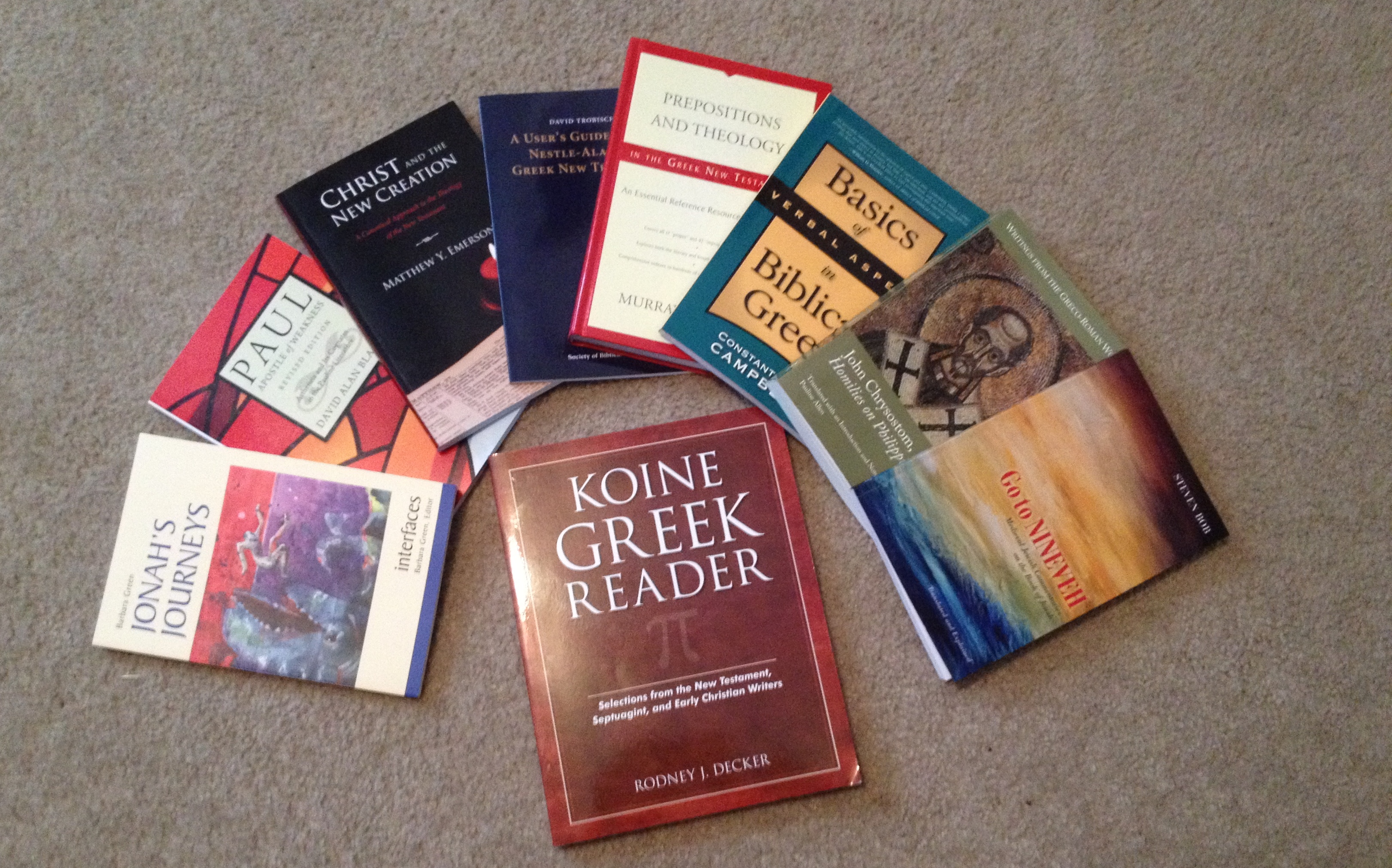
photoMy goal is to have all these books read and reviewed (or discussed on the blog) before the beginning of the new semester. Be on alert for a blaze of productivity . . . .

Posted in Book Reviews, Life | Tagged , , , , | Leave a comment

QOTD: Theodore of Mopsuestia

There are therefore two things that contribute to a person’s attaining beatitude: correct views on doctrine, for the purpose of having a dutiful and upright attitude toward God, and a disciplined moral upbringing, for living in an honorable and sound manner. Neither suffices for perfection without the other, each being supplemented or accompanied by the other; faith takes pride of place among them, just as in the body the head is given greater esteem than the other members. Still, for a person’s perfection, relationship with the other members and conjunction of the limbs also are required; likewise, for the full development of life, both these things must come together–namely, faith and life.

-Theodore of Mopsuestia

translated by Robert Hill

p. 5

Posted in Early Church Writings, Latin, Quotes | Tagged , , , | Leave a comment

On Memorizing Philippians

As some of you know, I have taken up the task of memorizing Philippians. Here are some reflections on my approach and some of the results.

Approach

  1. I try and dedicate at least 30 mins of concerted effort a day to the task of memorizing Philippians.
  2. Over the course of one week, I memorized 8 verses. Some of the verses were much shorter than others. For this reason, I am not attempting to reach a verse count per week.
  3. Before Mary Beth took vacation time from work, I would often walk to the grocery store with Elijah. During the walk, I would recite the verses I knew, and try and add more. This allowed me to accomplish three tasks at once: entertain the baby, grocery shop, and learn scripture.
  4. Though it is not set in stone, it seems to be the case that every other day I learn new material. On the days I do not learn new material, I solidify the verses I previously memorized. I have found that it is easy to memorize huge chunks of material only to forget it shortly thereafter. Constant and continual reinforcement, therefore, is essential.
  5. On days that I spend my 30 minutes reciting the verses I memorized, I attempt to think through the material as I recite. I try and interpret as I go. When Paul says, “μετα χαρας την δεησιν ποιουμενος,” I place emphasis on μετα χαρας. Doing this transforms rote memorization into an interpretive project.

Results

  1. My vocabulary is already increasing. In memorizing the verses, I ensure, before moving on, that I have memorized all the vocabulary contained therein.
  2. Memorizing the Greek text is not simply a task that enables me to reproduce a copy of the NA27. No, I am able to think through the Greek. I am able to translate as I go.
  3. Though this is tangential to the task of memorizing, as I translate through the homilies of Chrysostom, I am able to recognize textual variants without consulting the NA27.
  4. I find that I am beginning to know Philippians in a more intimate manner.

As I continue, I hope that the results will increase. I have no clue what the project will bear out. My prayer is that it will continue to deepen my knowledge of Greek, Scripture, and God.

Posted in Greek | Tagged , , | 1 Comment

What Happens When Dad Studies the OT?

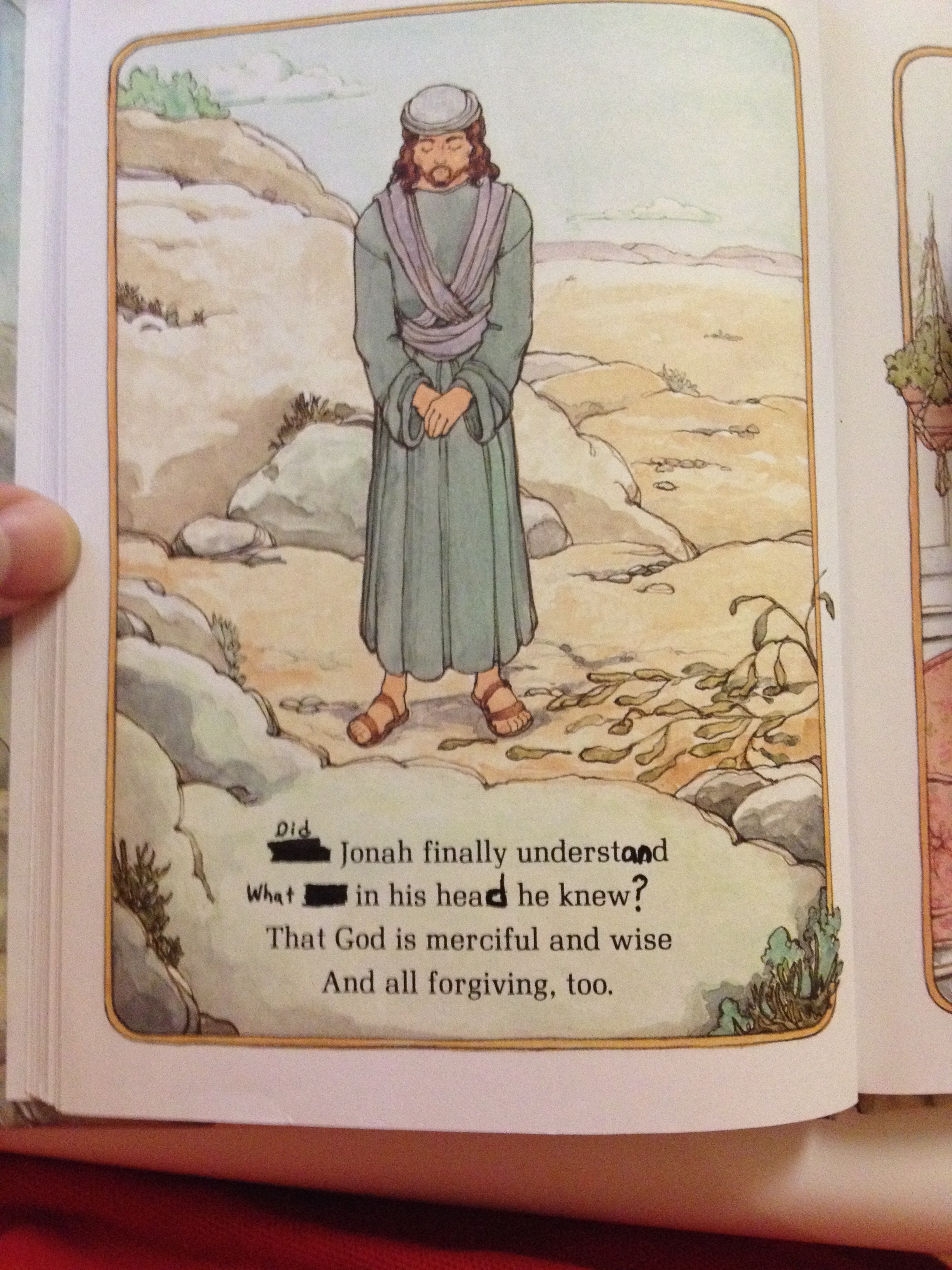
Yesterday, Mary Beth and I went to Goodwill to pick up some books for baby Elijah. We came across The Story of Jonah: An Alice in Bibleland Storybook.  Of course, yours truly read through the story before buying. I wasn’t surprised when I read the last page of the Jonah story. Here it is for you.

2013-12-20

Did Jonah ever truly understand? He acknowledges that God is merciful, wise, and forgiving with his mouth, but the story leaves us to wonder if his heart ever accepts the reality of these truths. Can you guess what happened next . . . ?

photo

You guessed it. I set pen to paper, and I made a few changes of my own. You’ll thank me for it one day, little Elijah 🙂

Posted in Jonah, Life | Tagged , , | 3 Comments

Memorizing Greek Philippians

About a month ago, one of my Greek Grammar students asked me about memorizing scripture. He asked if I memorized scripture in Greek and Hebrew, or an English translation. Much to his disappointment, and mine for that matter, I answered, “I don’t memorize scripture.” What? A seminary student that doesn’t memorize scripture? As counter-intuitive as this might sound, I think this is a rather common phenomenon.

When new students are introduced to a formal bible education, a number of things happen. First, we are taught that the versification in scripture is a much later addition in order to make finding passages easier. Second, we learn that verses should not be understood apart from themselves. They must be interpreted in light of the surrounding context. Third, we are introduced to the biblical languages, and we are taught that though English translations are reliable, as faithful servants, we should do our own work in the languages to free us to make the interpretive decisions which translators have made on our behalf. The result? Students stop memorizing scripture. The task of doing it, in our minds, has become too great. Instead of memorizing one verse, we must memorize a passage, a chapter, a book. Instead of picking our favorite translation, we know, in the back of our mind, that our time would be better spent memorizing from the original languages. But most neither have the time to memorize in the original languages, or the ability to translate or understand the Greek they have memorized.

I’ve decided, enough. It’s time to memorize scripture. I have been looking for ways to further develop my knowledge of Scripture, my Greek vocabulary, and my knowledge of Greek in general. Therefore, I am putting forth the necessary effort to memorize large chucks of scripture in the original text.

[Note: This is not a task for everyone. English translations are reliable. Pick the one you are most familiar with and read from on a daily basis and use that one. Memorizing the original Greek, for me, is based on the previous reasons listed, and the fact that the GNT has become the text from which I do my daily reading (after 7 years of Greek study).]

With all this in mind, and after a week of memorization, I present you with my recitation of Philippians 1:1-18. The pronunciation is according to the Erasmian system (sorry living language guys, I’m just too far gone).

[Note: There are two mistakes in my recitation. Hopefully the next recording will be perfect.]

In a later post, I will catalog, for those interested, my goals and approaches to memorizing the book of Philippians.

Posted in Greek, Greek Resources, NT Greek | Tagged , , | 2 Comments

A Hearty Thank You

photoYesterday was my birthday. One of Mary Beth’s gifts to me was a new, birch, floor-to-ceiling bookcase (92″ x 42″ x 12″). It is gorgeous. As I loaded the shelves with the books I have downstairs, a rather pithy thought occurred to me. You can’t buy friends, but friends can buy you friends. Let me explain.

When I became a Christian, a rather drastic change took place. Aside from the rather obvious changes that might take place when one moves from unbelief to belief, something rather unexpected happened. I started to read. I wanted to know. For perhaps the first time in my life, to my recollection, I was no longer satisfied playing baseball, skateboarding, or any other activity. My outgoing, social, and active nature receded, giving way to a life consumed by books, contemplation, and conversation with those who have gone before me.

Throughout this metamorphosis (really, how long did you think I would go without using that cliche?) friends and family have come alongside me, and have contributed to my intellectual development. Over the past decade, they have put up with my relentless requests for nothing other than books for Christmas and Birthday presents. They have bought me friends. They have purchased an endless supply of conversation partners from all eras of Church History.

I distinctly remember the day I asked Dustin Crowe, my first roommate at Moody Bible Institute, and Mike Lynch for book suggests. They introduced me to Luther’s Bondage of the Will (I read it in a sitting while pulling an all nighter before the men’s breakfast Piper came to speak at), John Owen’s Mortification of Sin, and Augustine’s Confessions. It didn’t take that much longer for me to develop a deep love of Historical Theology. In response, my parents purchased the Patristics Series, Luther’s Sermons, and Calvin’s Commentaries.

From my reading of Owen’s Mortification of Sin came an appreciation for the warm piety, precision, and insight into the soul and human nature so characteristic of the Puritans. Chuck Neely, a man responsible for building 1/4 of my library and good friend, gifted me the works of John Owen and Jonathan Edwards. The pastoral staff at Cary Alliance, along with Chuck, gave me Charles Simeon’s Expository Outlines on the Whole Bible. This set was lovingly constructed, volume by volume, by Chuck Neely.

My first date with Mary Beth centered around a discussion of Edward’s A Dissertation Concerning the End for Which God Created the World. The very fact that she attempted to read it, engage with it, and discuss it with me on a first date made me know she was a keeper, though I didn’t tell her that until three years later.

Edwards also became a regular topic of conversation in the Massengill household. I can’t tell you how many conversations I had with mom Massengill about Edward’s theology and how it shaped American literature in the works of Harriet Beecher Stowe and others.

The works of Spurgeon, G. K. Morgan, Warfield, Wesley, Bavnick, Mueller, and countless other authors both in this bookcase and in others around the house have been gifted to me by my parents, Mary Beth’s parents, Mary Beth, my brothers, my sisters, Chuck Neely, Pastor Gregory, Scott Eichleberger, Mike Lynch, and too many others to name. I cannot thank you enough. I can never repay you. Know that every time I consult a book for research, I remember the person that gave it to me. I thank you for your friendship throughout the years, and I thank you for buying friends for me that are available for a conversation no matter the time, day or night. Know that I remember your gifts, and also know that every time I drink deeply from their wisdom, I seek to faithfully use the gifts God has given me for the furtherance of his kingdom.

Posted in Life | Tagged , , , , , , , | 5 Comments