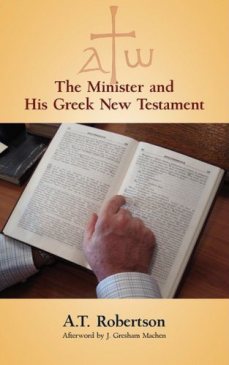
 Earlier today I read a great post over at biblioskolex entitled Review: The Minister and His Greek New Testament. The post, as it suggests, is a review of A. T. Robertson’s The Minister and His Greek New Testament, a collection of essays on the Greek New Testament.
In the post, the author provides a number of great quotations that are sure to make every student, minister, and scholar evaluate the amount of time he spends in the biblical texts, especially in the original texts. Here’s a sampling:
The preacher cannot excuse himself for his neglect of Greek with the plea that the English is plain enough to teach one the way of life… We shall have many more [English translations]. They will all have special merit, and they will all fail to bring out all that is in the Greek. One needs to read these translations, the more the better. Each will supplement the others. But, when he has read them all, there will remain a large and rich untranslatable element that the preacher ought to know. (p. 18-19)
He is no theologian who is not first a grammarian. (22)
If the blind guide leads the blind, they will both fall in to the ditch. One simply has to know his parts of speech if he is to keep out of the ditch, and avoid dragging his followers after him. Schisms have arisen around misinterpretations of single words. Grammar is a means of grace. (21)
I encourage you to click over to the post for more.
The post itself reminded me of a constant internal debate I have with myself regarding the modern minister’s relationship to the biblical languages. Naturally, as my focus is in the biblical languages, I am inclined to believe that everyone should and, dare I say, must study what I am interested in. In all seriousness, since the minister is charged with understanding, interpreting, and delivering the word of God to his people, it seems only fitting that he should have a grasp of what the word says in the original languages.
And yet, there is another part of me that recognizes that I’m not inclined towards the proper study of ethics or philosophy, both of which have bearing on religion generally and biblical studies particularly. Each of us has our strengths, weaknesses, likes, dislikes, areas of interest and disinterest. Very few are gifted jack of all trades in the study and application of the Bible. God has provided each member of the church—including the minister—with gifts according to the needs of the larger body, and that may or may not include knowledge of the biblical languages.
Yet again, should we not expect the ministers—and elders for that matter—to have the ability to offer answers to individuals in the congregation who ask: What does it say in the Greek or Hebrew? Why is this translated in various ways? Why do some translations have only one sentence for these six verses when others have six?If those charged with the task of leading the church cannot provide answers to these questions and speak with confidence from their own studies, who will?
And the cycle continues.
I’m curious to hear your thoughts on the matter:
Should all ministers be required to know the biblical languages? If so, why?
Are there any exceptions? What are they?
[Disclaimer: My attempt here is not to call into question the validity of or the Spirit’s use of ministers who do not know the biblical languages. I know of many who have had God-glorifying ministries and who have seen great fruit in those ministries without a knowledge of the biblical languages, and I thank God for them. I am simply asking us to wrestle with what our expectations ought to be regarding the minister’s relationship to the biblical languages.]





 What Jonah finds is also what he sought when he looked for a place where God would not be. And one might show the irony of this kind of answer, which we can sometimes get too. Jonah really wanted to go where he would be separated from God and would no longer hear his word. He is now there, in hell, but it is not where he wanted to go. Yet it is the only place corresponding to his wish. Not totally so, for this hell, like the fish, serves God’s word. God is still the master there. But this does not alter the fact that for Jonah the separation is total. His prayer, however, will bring about his liberation.
 Last night I noticed that Marilynne Robinson’s newest novel was available for preorder (Oct 7). This is the third novel of Robinson’s set in the fictional town Gilead. I loved the previous two, Gilead and Home, and couldn’t resist the opportunity to pick up this novel.


 ἐνθύμησις