Membership in a Local Church

Last night Mary Beth and I attended one of the quarterly “All Members Nights” at Vintage21.  This is a night where all members and membership candidates join together for a time of worship, updates, and planning.  During the meeting the pastor made an unsettling comment: “All of you here tonight, the members, are the local body of Christ.”

Now, I am forced to give him the benefit of the doubt.  After all, Vintage21 is a church composed of Christians, doubters and seekers.  It would not be accurate to say that all these individuals are a part of the body of Christ.  But is it accurate to say that only the members of a local church are to be considered part of that local expression of the body of Christ?  Are individuals who have attended, served, given financial over a period of weeks, months, years not considered to be a part of the local body of Christ?

This forced me to consider my theology of membership in general.  Where does the concept of being a “member” of a local church come from?  I can’t recall any particular biblical text that lends to the concept of membership; believers gathered together weekly for worship, communion, baptism, fellowship, and song, but there is no mention of membership logs.  Where have we derived our theology of membership?

Please don’t misunderstand me.  The modern church practice of membership has many benefits.  Membership allows the church to distinguish between her regenerate and non-regenerate attendees (only God ultimately knows who is regenerate and who is not, but signs and evidences of true faith are usually required for membership).  Membership allows the church to exercise church discipline.  I remember an incident in a previous church I attended where a man was openly having an affair, refused to repent and was publicly disciplined by the church.  Later he attempted to sue for defamation of character.  Yet, in becoming a member the individual submits himself to the church’s authority.  Membership in congregational churches insures that only the regenerate vote for those who will lead the church.

Despite all these benefits and more, I struggle to find a biblical basis for the concept of membership.  That’s not to say it doesn’t exist.  I simply don’t have the answers.  Do you?  Does membership in a local church have biblical basis?  How has the concept of membership developed historically?  Drop me a line!

Posted in Life, New Testament Studies | Tagged , | 5 Comments

Greek NT Reading Calendar 2012

Over at “The Upper Register” Lee Irons has provided a Greek reading calendar for 2012.  He provides two options: read through the NT in one year or in two years.  He has divided the daily passages up into content-based sections.

I will make it my goal to get through the NT this year.  What about you?

Posted in Greek Resources, NT Greek | Tagged | 1 Comment

Work for Glory

Martin Luther was instrumental in changing the religious world.  This fact shouldn’t come as a surprise to many of you.  But you may not know that his theology had substantial import for the believer’s involvement in the socio-economic world.

Vocation, from the latin voco “to call,” was specifically used to describe the nuns, monks, priests bishops, cardinals, (i.e. the religious order) of Luther’s day.  This “class” of individuals had a “calling” from God, and their work was of supreme importance.  These posts carried a significance absent in all other professions.  Farmers, doctors, lawyers, politicians all had their work, but the religious order possessed a “calling” from God.  This medieval theology of clergy was imbued with an air of piety and superiority.

Luther’s theology of vocation radically changed the believer’s perception of his role within the two kingdoms (kingdom of heaven and the kingdom of earth).  Luther understood the believer’s “calling” is to live out his faith in all of life: family, work, culture.  The clergyman is no longer elevated above the computer programmer or the file-clerk.  Instead, every believer shares the same calling, to glorify God in all facets of life by being vessels for the Gospel.

I have known and believed this for some time now.  I have encouraged Mary Beth on countless occasions that her work is for the kingdom.  Even so, I never had to face the reality of this truth.  For the past 7 years I have been a part of the “clergy” or in school for that purpose. It wasn’t difficult to live out the theological implications of vocation.

Finding myself in a family law office as a file-clerk forty hours a week has been difficult.  The time for study, ministry, reading, writing and prayer has been reduced.  The monotony of the job has set in, and I find it difficult to start the day with a good attitude, much less keep it throughout the day.  At the heart of the matter is my selfishness.  Instead of seeing my current job as a means to glorify God at this time in my life, I have seen it as a means to an end, a necessary evil in order to facilitate my re-entry into academia.

An understanding of vocation that forces the believer to remember his first love and seek the glory of God is convicting.  I am guilty.  I have treated time as if it is mine.  It is God’s and it is to be used for his glory.  I have robbed this time in my life of any ability to glorify God because of my hubris associated with the ministry and biblical scholarship.  It must die.  I must die, so that Christ and his Gospel might live through me.

Posted in Life | Leave a comment

Apostolic Fathers: Ephesians

I came across this quote today in the Ephesians 4:1-2 (the Ephesians of the Apostolic Fathers…not the biblical book):

τὸ γὰρ ἀξιονόμαστον ὑμῶν πρεσβυτέριον, τοῦ θεοῦ ἄξιον, οὕτως συνήρμοσται τῷ ἐπισκόπῳ ὡς χορδαὶ κιθάρᾳ. διὰ τοῦτο ἐν τῇ ὁμονοίᾳ ὑμῶν καὶ συμφώνῳ ἀγάπῃ Ἰησοῦς Χριστὸς ᾄδεται.  καὶ οἱ κατ᾿ ἄνδρα δὲ χορὸς γίνεσθε, ἵνα σύμφωνοι ὄντες ἐν ὁμονοίᾳ, χρῶμα θεοῦ λαβόντες, ἐν ἑνότητι ᾄδητε ἐν φωνῇ μιᾷ διὰ Ἰησοῦ Χριστοῦ τῷ πατρί, ἵνα ὑμῶν καὶ ἀκούσῃ καὶ ἐπιγινώσκῃ, δι᾿ ὧν εὖ πράσσετε, μέλη ὄντας τοῦ υἱοῦ αὐτοῦ. χρήσιμον οὖν ἐστιν ὑμᾶς ἐν ἀμώμῳ ἑνότητι εἶναι, ἵνα καὶ θεοῦ πάντοτε μετέχητε.

Translation: “For your body of presbyters, being worthy of its name and worthy of God, is attuned to the bishop as the strings are to a harp.  Therefore, Christ is sung in your unity and harmonious love.  And also every man must become this chorus, so that being a harmonious unity, receiving your pitch from God, you might sing in unison with one voice through Jesus Christ to the Father, in order that he might both hear and recognize you, because of the things you do well, partaking in the melody of his Son.  Therefore it is advantageous for you to be in unbroken unity, so that you might always partake of God.”

Permit me a few observations:

  1. The author of this letter hopes to pass it off as a genuine Pauling epistle.  Yet, the ecclesiology of the extant Pauline corpus does not remotely approach the hierarchical presentation of bishops ruling a synod/group/counsel of elders/presbyters ruling the laity.
  2. The pervasive nature of works righteousness has always fascinated me, especially when reading the Apostolic Fathers.  Notice that the ability to “always partake of God” seems to be contingent on remaining in unbroken unity.  This unity, as indicated in 3:2 travels up the hierarchy: the presbyters have the mind of the bishops who have the mind of Christ who has the mind of the Father.
  3. Despite the areas of theological disagreement, I found the analogy quite powerful as it draws off and is an expression of Paul’s analogy of the church as the body of Christ.  We all partake in a divine song.  Each member plays an instrument.  The piece is expressed in its fullest when every member participates.  A member of the “melody of the Son” cannot start playing chords from another tune.  He must take his pitch from the Father and play (run) the song (race) marked out (set before) him.  Let us each build up and encourage our fellow musicians.  For the more we seek to exalt ourselves so that others might be drowned out, the more we reveal that we are not “partaking in the melody of his Son.”
Posted in Apostolic Fathers | Tagged | Leave a comment

Word of the Day

νομοθέτης, today’s Greek word of the day, comes from Philo’s de mundi opificio (If I am not mistaken, the translation being “Concerning the Creation of the World”).

νομοθέτης is made up of two words: νόμος “law” and τίθημι “to give.”  Μωυσῆς ῆν μεγάλος προφήτης καὶ νομοθέτης ἐν Ισραηλ “Moses was a great prophet and lawgiver in Israel.” [note: this is not a quote form Philo but a fabricated sentence]

A few statistics: νομοθέτης is used once in the NT (James 4:12), once in the LXX (Psalm 9:21), 130 times in Philo, 51 times in Josephus, once in the Apostolic Fathers (Barn 21:4) and 10 times in the Pseudepigrapha (mainly in Aristeas and  Aristobulos).

Posted in NT Greek | Tagged | Leave a comment

Revisiting Past Work

I hate reviewing my work.  This includes listening to sermons I have preached and re-reading papers I have written.  Why?  Because it is a humbling experience.  For me it is embarrassing to know that I submitted sub par work.  But ignoring it…well…that helps to keep one’s ego intact.

Well, my ego is gone.  I have been reading through a number of journal articles lately in order to beef up the bibliographic section of my paper entitled “The Baptism of Jesus and the Fulfillment of all RighteousnessAn exploration of Jesus’ typological relationship to Israel in Matthew 3:13-17.”  It is my hope to submit this paper to the regional meeting of ETS.  I thought that the extent of my work would be in strengthening my arguments through citation and revising the piece for its new context.

I pulled the paper out in order to find what sections needed minor tweaking and where sources needed to be added.  I discovered that there were typos, instances where I fell into passive voice, several paragraphs in need of a complete overhaul, unsupported statements, ill supported conclusions and sources that should have never been cited in the first place.  The most humbling part of this experience is the fact that I have and still do esteem this as one of my best papers in terms of originality, research and argumentation.

I am finding that the moment I think I have “arrived” is the moment pride takes over, growth stops, laziness sets in, and my work suffers.  Lord, help me to always rely on you and to recognize that what little talent I have has been given by you, is honed by you, and should be used for your glory.

Posted in New Testament Studies | Tagged | Leave a comment

The Baptism of Jesus

I am a bit distraught.  I have been utilizing an invaluable resource I received as a Christmas present from several family members in order to further conduct my research in the area of the baptism of Jesus in Matthew 3.  I started with the Westminster Theological Journal and was delighted to find that 7 articles addressed my passage with a keen eye towards the entire biblical narrative (Old and New).  Trinity’s contained approximately 3-4 articles (one was even co-authored by Dr. Michael Travers, English professor at the College of Southeastern).  Another feature of these articles that stood out was the distinction made by each author between the baptism of John, Jesus and New Covenant or Christian baptism.

Yet, the moment I began searching the Southern Baptism Journal and the Reformed Baptist Journal all I found were articles arguing for immersion as the mode of baptism and believer’s baptism as the only legitimate form of Christian baptism.  This, though, was not surprising.  As a matter of fact I expected this, after all this is a primary doctrinal distinctive of the Baptist denomination (a camp with which I associate).  I did not expect to see John’s baptism and the baptism of Jesus linked to these arguments.  After all, later New Testament passages require those baptized by John to receive Christian baptism.  Also, John makes a distinction between Jesus’ baptism and that of his own (he will baptize with spirit and fire).  Furthermore, how is it that Jesus’ baptism can be characterized as a symbol of repentance and for the forgiveness of sins?  After all, he was sinless…wasn’t he?

It seems as if citing the baptism of Jesus, at least Matthew’s account thereof, as support for the mode, means, method, meaning, etc. of Christian baptism ignores the surrounding context.  John makes it clear that Jesus’ request for baptism is dissonant with his form of baptism (I have need to be baptized by you).


Posted in New Testament Studies | Tagged | 1 Comment

Fun in Vaticanus: Citations and Divisions

Greek students, what are the cardinal rules you were taught in Bible College and or Seminary about the basic features of Greek manuscripts?  There is no versification, there is no punctuation, there are no formal citations, there are no paragraph divisions, there are no divisions between the words, and uncial texts are written in ALL CAPS.
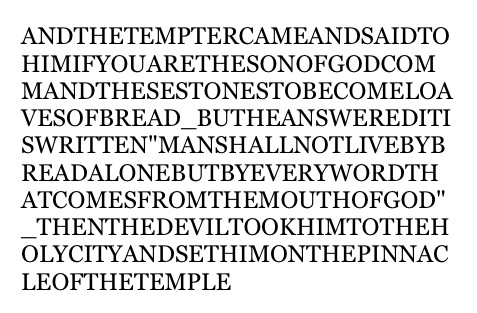
So far we have seen some of these features in Vaticanus.  It is an uncial text and thus all the characters are capitalized.  Furthermore, there are no word divisions or versification.  Instead, it is an almost unbroken stream of text.  We have found no punctuation, which also means no quotation marks are used to indicate a change of speaker within the narrative.  But it may surprise some of you to know that there both citations and divisions in these ancient codices.

Look at the text to your left, now look back at me, now look back at the text, now look back at me…anyways, the first six letters are the end of what we know to be Matthew 4:3.  Now look really close at what comes next.  What do you see?  That was kinda a trick question.  There isn’t anything there.  It is a space that indicates the beginning of a new section…of sorts.  Now look down at the very bottom of the image.  There is another space at the end of what we know to be verse four.  Matthew 4:3-5 reads about like this ( _ indicates a space),

Notice that, at least in this instance, the breaks in the text indicate a shift in speaker.  Whether these spaces were present in the original autograph, I do not know.  I do know that they are here in Vaticanus and are also present in Sinaiticus (two third century texts).

The close reader of the above english translation might ask, “why do you have quotation marks?”  In a previous post I made mention of a mysterious ל “lamad.”  This occurs throughout the codex and marks the text as quoted.  This is not the only feature concerning quotations.  Look back up at the image and train your eye to the bottom left. There is an abbreviation in red that reads ΙΖ with a macron overhead.  Any guesses?  That’s right, the scribe has noted that the quotation comes from Isaiah.  Since information on the features of these codices is scant (really…I just don’t know where to look quite yet), I do not have a clue as to when these markings appeared on the manuscript.  But wherever there is a ל “lamad,” there is also a red lettered citation.

Posted in NT Codices | Tagged | 1 Comment

Indecision

As I sit on my front porch enjoying a favorite past time my mind wanders to past experiences, to friends still here and those that have passed into eternity.   Our conversations about life, theology and future aspirations still influence me today.  These things force me to contemplate my present state and future goals.

I cannot help but feel scared and ill-equipped.  I do not believe there is a question about where I belong.  There is nothing that excites me more than a new book.  Therein a host of new concepts and perspectives await my attention.  And afterwards?  It will be my job to share my newly acquired knowledge with eager and impressionable students.  For of what use is knowledge if it is not given as eagerly as it was received.  I belong in a school…I belong in the scholarly world.

Why am I pensive and afraid?  My interests are broad and transitory.  In the last two to three weeks I have studied and neglected the LXX, studied and neglected German, studied and neglected the codices, and am now reading as many articles on baptism in order to revise a 2-year-old paper in hopes of presenting it to the regional meeting of the Evangelical Theological Society.

This seems to be a prevailing characteristic of my studies.  At Moody it was Systematic Theology, then I became attached to Historical Theology, and finally the Greek language.  As soon as I began at Southeastern, Heath Thomas’ “Old Testament Theology” class was breathtaking.  Never before did the Old Testament invoke interest.  And yet, I ardently studied Hebrew and the Old Testament.

The root of the problem?  I have the attention span of a two-year-old opening Christmas presents.  What’s next?  Unless I am writing a paper on a specific thesis, I rarely ever go deep enough into a subject to become proficient.  The concept of a 150+ page thesis terrifies me.  Some of you might be thinking, “The concept of a 15 page paper terrifies me.”  Yet, my horror doesn’t come from the page length or that I will have to write.  After all, I think I write pretty good.  Instead, I recognize the amount of dedication towards one subject, one paper, one thesis that is required.

Please don’t misunderstand.  I am thankful that my interests are broad.  It keeps me from becoming myopic.  I have my friends to thank for those interests.  Matt Kelly, thank you for being passionate about language.  Thom Desmond, thank you for having a pastors heart.  Mike Lynch, thank you for you dedication to precision and systematics.  Nathanial Cooley, thank you for your love of the biblical narrative.  Dustin Crowe, thank you for your attention to the thoughts of those who have gone before.  Kyle Talbot for…well…everything.  Adam for apologetics, Josh for counseling, Ben for ethics and the list goes on.  Above all, thank you to my wife that puts up with my bouts of obsessive behavior.

I only pray that I will be able to find the thing that drives me.  The love that grips my soul and will not depart.

Posted in Life | Tagged | Leave a comment

Fun in Vaticanus: Some More Features

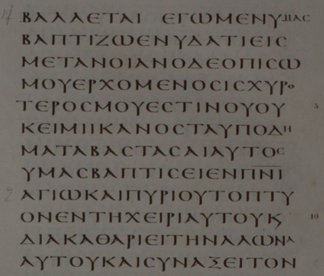
I am continuing to find a number of interesting features in Codex Vaticanus.  The first example is taken from Matthew 3:7, the second is taken from Matthew 3:11-12.

If a word ends in a “Ν” and there is no room for it at the end of a line of text, then they place a makron over the last letter to signify its absence.  This is what we have in the first image, γεννηματα εχιδνω[ν] τις υπεδειχεν υμιν φυ…  Notice that the ν is not a part of the text.  Instead, there is a macron/line over the ω.  This seems to be a rather consistent practice.

Now look at the last letter on third from last line.  It is a funky looking Κ. There is an extra line that cuts back toward the letter.  This letter is an abbreviation for the word ΚΑΙ/και “and.”  It seems to only appear that the end of a line.

Finally, I found another instance of the nomina sacra.  The last three letters of line 8 (from the top) are ΠΝΙ with a macron overhead.  This is the nomina sacra for Holy Spirit.  Two features should be noted.  First, the case of πνευμα “spirit,” dative, is maintained by the presence of the ΠΝΙ.  Second, the next word ἁγιῳ “Holy” has not been abbreviated.

Posted in NT Codices | Tagged | 1 Comment